
Electric SUVs Comparisons
Hyundai Ioniq 5 vs Kia EV6: Complete Comparison (Performance, Range & Features)

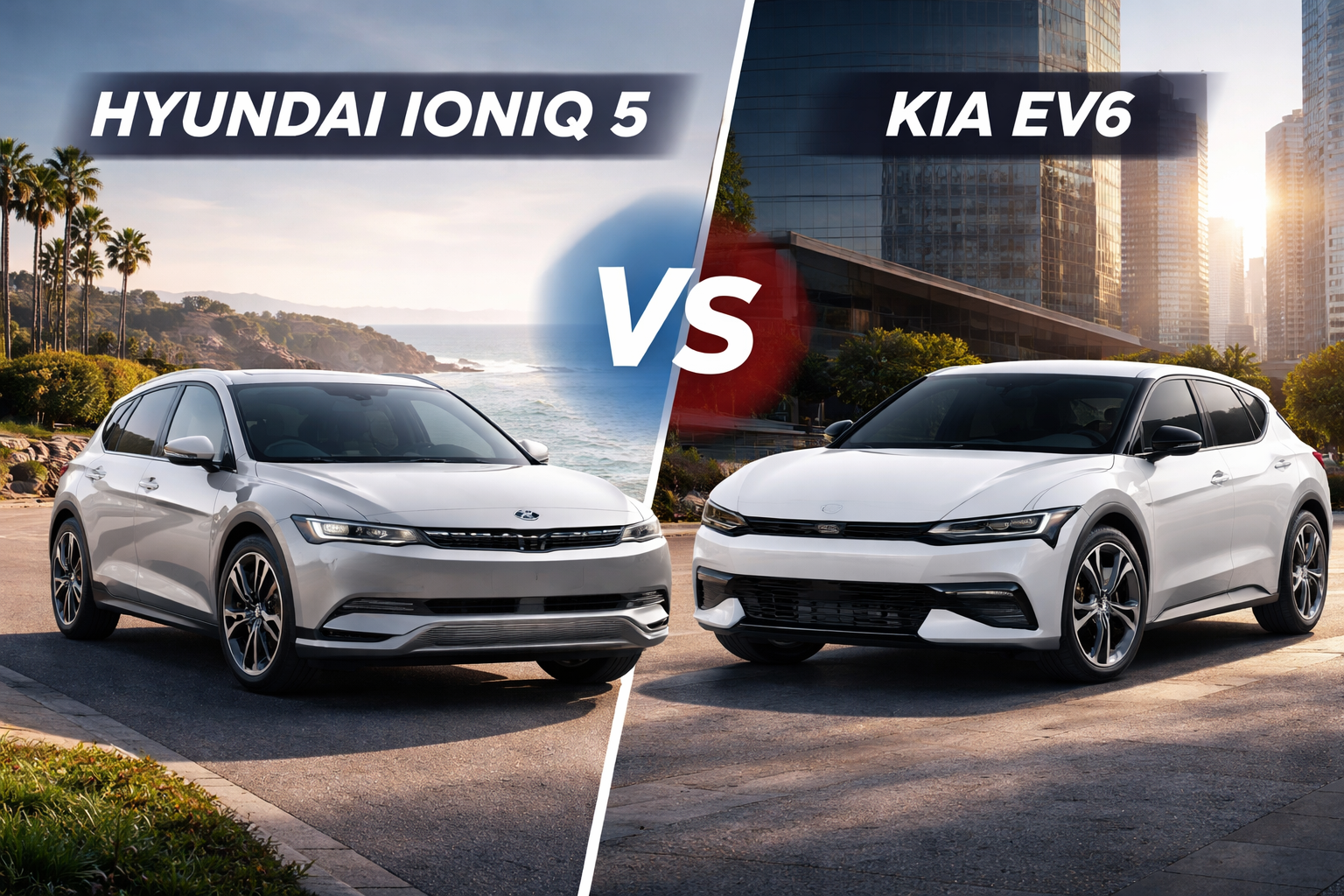
Electric vehicles are no longer the future; now they are the present. Over the past few years, the EV market has evolved rapidly, with electric SUVs becoming the top choice for modern drivers. Among the most talked-about options today are the Hyundai Ioniq 5 and Kia EV6, two groundbreaking models redefining what electric mobility looks like.
If you are researching the Hyundai Ioniq 5 vs Kia EV6, you are likely comparing two of the best electric SUVs available today. Both vehicles share advanced engineering, ultra-fast charging capabilities, and impressive driving performance. However, they also differ in key areas that can significantly impact your buying decision.
Moreover, these EVs represent a new generation of electric cars built on dedicated platforms, not adapted from petrol vehicles. As a result, they offer superior space, efficiency, and driving experience compared to traditional SUVs.
Overview of Hyundai Ioniq 5 and Kia EV6
The Hyundai Ioniq 5 and Kia EV6 are built on the same advanced E-GMP platform. This shared architecture allows both vehicles to deliver exceptional performance, efficiency, and ultra-fast charging capabilities. However, despite sharing core engineering, they cater to different types of drivers.
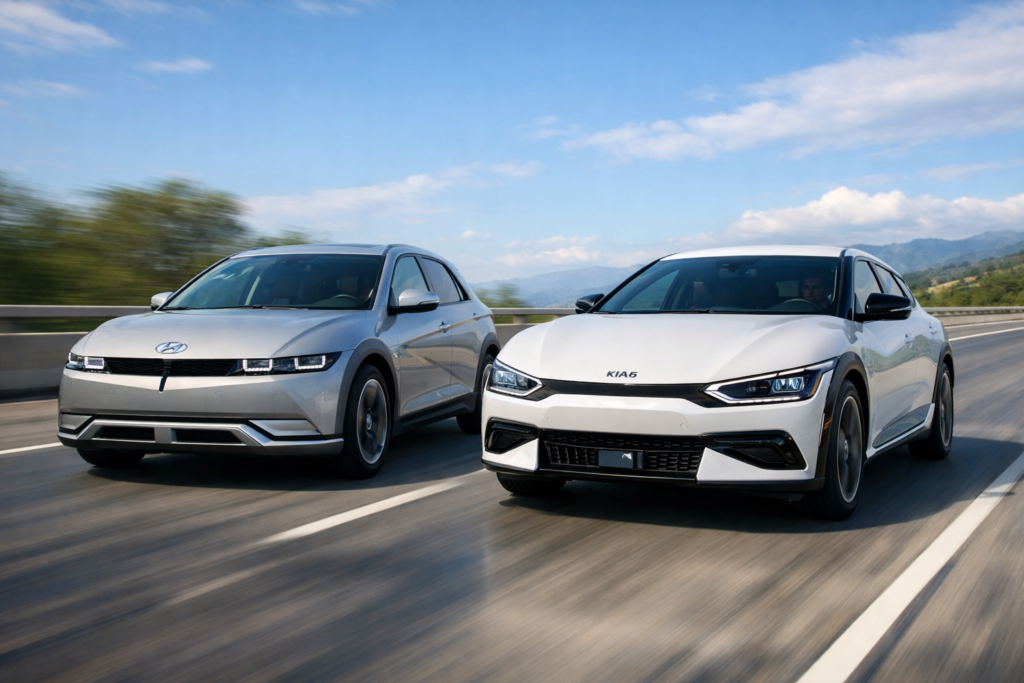
Hyundai positions the Ioniq 5 as a comfort-focused, futuristic family SUV. In contrast, Kia markets the EV6 as a sporty and dynamic electric crossover. As a result, buyers must choose between comfort and performance rather than technology differences.
Both models compete directly with vehicles like the Tesla Model Y, Ford Mustang Mach-E, and Volkswagen ID. 4. However, their combination of range, charging speed, and design innovation provides them a strong competitive edge.
Design and Exterior Differences
The Hyundai Ioniq 5 and Kia EV6 may share the same platform, but their exterior design clearly targets different audiences. Hyundai has taken a bold and unconventional approach, while Kia focuses on sporty and premium styling. This difference plays a big role in how each vehicle is perceived on the road.

In simple terms, the Ioniq 5 is ideal if you prefer a unique, practical, and spacious design. The EV6 is the better choice if you want a stylish, sporty, and more aggressive-looking electric SUV. While the Ioniq 5 has mainly focused on future-ready design.
Hyundai Ioniq 5 Design Philosophy
The Hyundai Ioniq 5 features a retro-modern design inspired by the original Hyundai Pony. Its sharp lines, pixel-style LED lights, and bold stance make it stand out instantly. Moreover, its boxy shape enhances interior space while improving aerodynamics.
In addition, the Ioniq 5’s unique styling appeals to buyers who want something different. It feels futuristic yet nostalgic, blending past and future seamlessly. It is a better option for you due to its sleek and modern design.
Kia EV6 Sporty Styling and Aerodynamics
On the other hand, the Kia EV6 takes an entirely different approach. Its sleek, coupe-like profile provides it a sporty and aggressive appearance. The sloping roofline and wide stance enhance its aerodynamic efficiency.
Furthermore, the EV6 looks more premium and performance-oriented. Many drivers even compare its styling to high-end German vehicles, making it attractive for those seeking a sportier image.
Interior and Comfort Comparison
The Hyundai Ioniq 5 and Kia EV6 both benefit from their dedicated EV platform, which allows for better interior space than traditional SUVs. Since there is no engine or transmission tunnel, both vehicles offer flat floors and more usable cabin area. However, the way each brand uses this space is different.
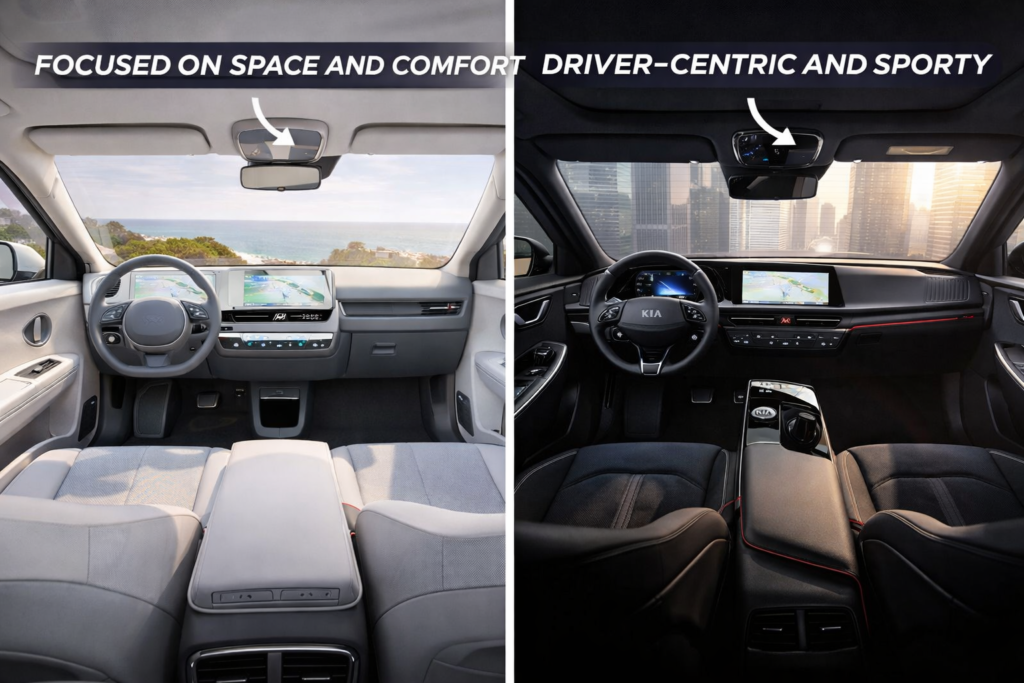
Overall, the Ioniq 5 is better suited for comfort, space, and family use. The EV6, however, offers a more premium and driver-focused interior that appeals to those who prefer a sportier environment.
Cabin Space and Seating Comfort
The Ioniq 5 offers one of the most spacious cabins in its class. Thanks to its flat floor and long wheelbase, passengers enjoy exceptional legroom. In fact, its interior feels more like a lounge than a traditional SUV.
Meanwhile, the Kia EV6 also provides adequate space but sacrifices some headroom due to its sporty roofline. While still comfortable, it does not match the openness of the Ioniq 5. The Ioniq 5 is better than the EV 6 in some ways, so it’s more compatible.
Infotainment and Technology Features
Both vehicles feature dual 12.3-inch displays with high-resolution graphics. They support Apple CarPlay, Android Auto, and advanced navigation systems. However, Hyundai’s interface feels slightly more intuitive. In contrast, Kia focuses on a more driver-centric layout, which may appeal to performance-oriented users.
Performance and Driving Experience
The Hyundai Ioniq 5 and Kia EV6 may share the same platform, but their exterior designs are entirely different. This difference is intentional, as both brands target different types of buyers. One focuses on bold uniqueness, while the other leans toward sporty appeal.

In simple terms, if you prefer a unique and spacious design, the Ioniq 5 stands out. However, if you want a sporty and premium-looking electric SUV, the EV6 is the better choice. Both are good in their specialties.
Acceleration and Power Delivery
Both EVs deliver instant torque, making acceleration smooth and responsive. Most variants achieve 0–60 mph in around 5 seconds, which is impressive for family SUVs. The EV6, however, offers more powerful variants, including the high-performance EV6 GT. This advantage makes it a better option for drivers who prioritize speed.
Handling and Ride Quality
The Hyundai Ioniq 5 focuses on comfort. Its softer suspension absorbs road imperfections, making it ideal for city driving. In contrast, the Kia EV6 offers sharper handling and a firmer ride. It feels more engaging on winding roads, making it better suited for spirited driving.
Battery, Range, and Charging Capabilities
The Hyundai Ioniq 5 and Kia EV6 both use the same advanced E-GMP platform, which allows them to deliver industry-leading battery performance. Both vehicles are available with a large battery pack of around 77.4 kWh, designed to support long-range driving.

From an ownership perspective, both vehicles also benefit from lower running costs compared to petrol SUVs. Charging at home is significantly cheaper than refueling, and maintenance costs are lower due to fewer moving parts.
Real-World Range Comparison
Both vehicles offer impressive range figures exceeding 300 miles in optimal conditions. The EV6 slightly edges ahead in maximum range depending on configuration. However, real-world driving conditions, such as weather and style, can affect range. Fortunately, both models provide reliable and consistent performance.

Charging Speed and Efficiency
One of the biggest advantages of these EVs is their 800V charging architecture. They can charge from 10% to 80% in around 18 minutes using fast chargers. Moreover, they support vehicle-to-load (V2L) functionality. This mode allows you to power external devices, making them highly versatile.

Safety Features and Driver Assistance Systems
The Hyundai Ioniq 5 and Kia EV6 both come equipped with advanced driver assistance systems (ADAS) that are designed to improve safety and reduce your fatigue. Since both vehicles are built on the same platform, they share many core safety technologies, but their tuning and user experience can feel slightly different.
Both models include adaptive cruise control, which automatically adjusts speed based on traffic conditions. This feature is especially useful on highways, as it maintains a safe distance from the vehicle ahead. In addition, lane-keeping assist and lane-following assist help you to keep the car centered in its lane, reducing the need for constant steering correction.

One standout feature in both vehicles is the blind-spot view monitor. When you activate the turn signal, a live camera feed appears on the digital instrument cluster, showing the vehicle’s blind spot in real time. This significantly improves safety during lane changes, especially in heavy traffic.
Both the Ioniq 5 and EV6 also come with automatic emergency braking, forward collision warning, and rear cross-traffic alert. These systems detect potential collisions and can apply brakes automatically if needed. As a result, they help prevent accidents in both city and highway driving situations.
Overall, both vehicles provide a high level of safety that matches or even exceeds many premium EVs. Whether you choose the Ioniq 5 or EV6, you’ll get a strong set of features designed to make driving safer, easier, and more comfortable.
Technology and Smart Features Comparison
The Hyundai Ioniq 5 and Kia EV6 both offer modern technology that enhances convenience, connectivity, and overall driving experience. Since they share the same platform, many of the core tech features are similar, but each brand presents them differently.
Both vehicles come with dual 12.3-inch displays, combining the digital instrument cluster and infotainment system. The screens are sharp, responsive, and provide useful information such as navigation, energy usage, and driving data. They also support Apple CarPlay and Android Auto, making smartphone integration seamless.
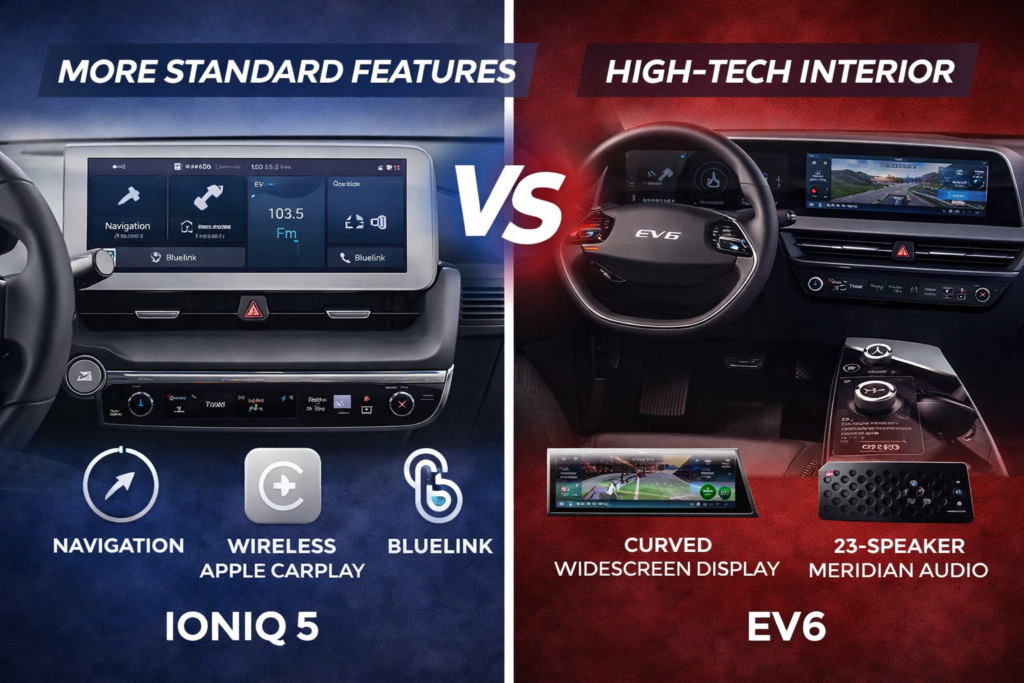
Hyundai focuses more on ease of use and simplicity. The Ioniq 5 includes physical buttons for important controls like climate settings, which makes it easier to operate while driving. Its interface is clean and straightforward, which suits users who prefer a less complicated system.
Kia, on the other hand, offers a more driver-focused and modern interface. The EV6 uses a touch-sensitive panel that switches between climate and media controls. While it looks more futuristic, it may take some time to get used to compared to Hyundai’s simpler layout.
Both vehicles also include features like wireless charging, voice controls, and over-the-air updates. Overall, the Ioniq 5 is better for users who want simplicity, while the EV6 appeals to those who prefer a more high-tech and sporty experience.

Pros and Cons of Hyundai Ioniq 5
Pros
The Hyundai Ioniq 5 stands out as a highly practical and comfort-focused electric SUV. Its biggest strength is its spacious interior, which offers excellent legroom and an open, lounge-like feel. This makes it especially suitable for families and long-distance driving.
Another major advantage is its smooth ride quality. The suspension is tuned to absorb bumps and rough roads effectively, making daily commuting more comfortable. In addition, its unique retro-modern design gives it a strong visual identity that stands out from typical SUVs.

The Ioniq 5 is also very user-friendly, with a simple infotainment system and physical controls for key functions. Combined with fast charging and solid range, it provides a well-balanced ownership experience.
Cons
However, it does have some downsides. The driving experience is more relaxed, which means it may feel less exciting for drivers who prefer sporty handling. Additionally, while the design is unique, it may not appeal to everyone’s taste.
Overall, the Ioniq 5 is best suited for buyers who prioritize comfort, space, and everyday usability over performance.
Pros and Cons of Kia EV6
Pros
The Kia EV6 is designed to deliver a more sporty and engaging driving experience compared to the Ioniq 5. One of its biggest strengths is its strong performance, especially in higher trims. Acceleration feels quicker, and the overall driving dynamics are sharper, making it more enjoyable on highways and curvy roads.
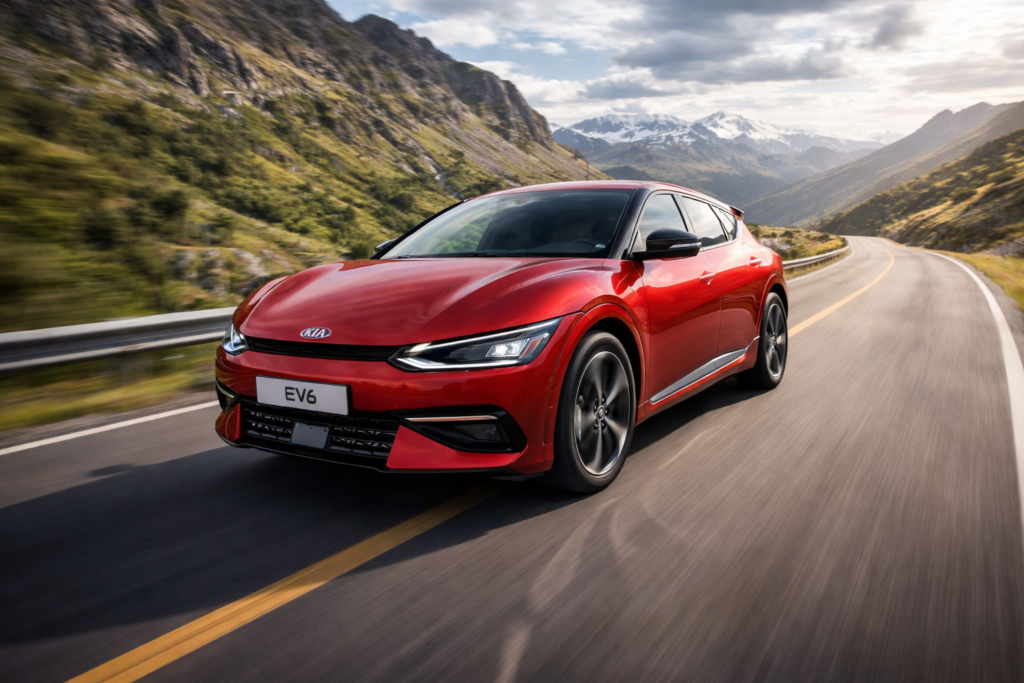
Another key advantage is its premium interior feel. The EV6 uses darker tones, high-quality materials, and a driver-focused layout that gives it a more upscale and modern atmosphere. Its sleek exterior design also adds to its appeal, making it one of the best-looking electric SUVs in its segment.
The EV6 also benefits from the same fast charging and advanced tech features as the Ioniq 5. This means you’re not sacrificing practicality for performance. It still offers good range, quick charging times, and useful features like Vehicle-to-Load.
Cons
However, there are a few drawbacks. The firmer suspension can make the ride slightly less comfortable on rough roads. In addition, the sloping roofline reduces rear headroom a bit, which may not be ideal for taller passengers.
Overall, the EV6 is best suited for drivers who want a balance of modern technology and sporty performance, even if it comes with slightly less comfort and space.
Which electric SUV is better for you?
Choosing between the Hyundai Ioniq 5 and Kia EV6 ultimately comes down to your personal driving needs and preferences. Both vehicles offer similar core technology, fast charging, and strong range, so the decision is more about how you plan to use the car daily.
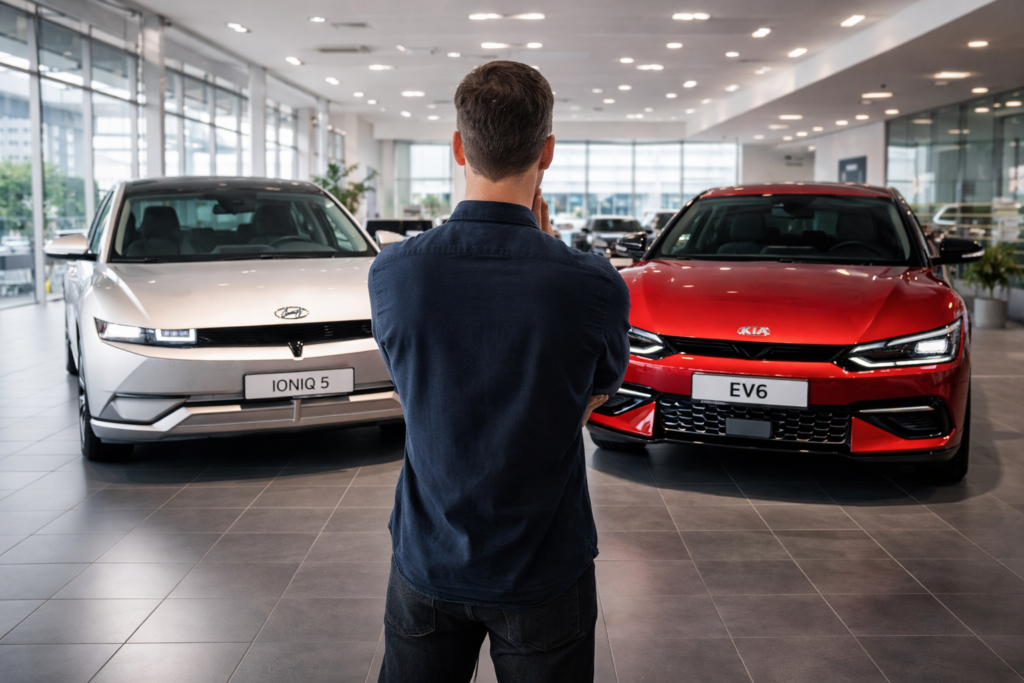
If you prioritize comfort, space, and practicality, the Hyundai Ioniq 5 is the better option. Its larger cabin, smoother ride quality, and flexible interior make it ideal for families, daily commuting, and long-distance travel. It’s a great choice if you want a relaxed and easy driving experience.
On the other hand, if you prefer a more sporty and engaging drive, the Kia EV6 stands out. Its sharper handling, stronger performance variants, and premium interior feel make it more exciting to drive. It suits buyers who enjoy a more dynamic driving experience.
In simple terms, the Ioniq 5 is the better all-rounder for comfort and usability, while the EV6 is better for performance and style. Since both are excellent electric SUVs, your final decision should depend on which driving experience fits your lifestyle better.
Which is better, EV6 or Ioniq 5?
The EV6 has sportier dynamics, but the Ioniq 5 is good in performance and innovation and is comfortable, making it a complete package for you. Meanwhile, the Ioniq 5 is like old-age-designed SUVs.
What is the Kia version of the Hyundai Ioniq 5?
The Kia version of the Ioniq 5 is the Kia EV6, which has many similarities. Like both have the futuristic design and advanced technology and are eco-friendly. These qualities play an important role in making the Ioniq 5 and EV6 popular electric SUVs.
Is EV6 faster than Tesla?
The EV6 GT has crushed the Tesla Model Y in performance. It has the total power of 640 HP, which is two times that of Model Y. Not just in power, the EV6 accelerates more fastly, within 3.3 seconds, to reach from 0 to 60 mph.
Is Hyundai a luxury version of Kia?
As the Hyundai group owns both companies, they equally work on both brands’ models. Both Hyundai and Kia have used high-quality materials and added luxury features in their top models to become popular among the world faster.
Conclusion
The Hyundai Ioniq 5 vs Kia EV6 comparison highlights two of the best electric SUVs available today. While both share advanced technology and impressive performance, they cater to different driving styles.
The Ioniq 5 excels in comfort, space, and practicality, making it perfect for everyday use. Meanwhile, the EV6 offers a sportier, more dynamic driving experience. Ultimately, your choice depends on your lifestyle and driving preferences. Before making a decision, explore detailed comparisons and test drives to find the best fit.

The debate between electric SUVs vs. hybrid SUVs has never been more relevant than it is in 2026. More drivers than ever before actively seek fuel-efficient alternatives to traditional gasoline-powered vehicles.
Modern electric vehicles and hybrid SUVs now offer impressive performance, comfort, and technology that rival conventional options. Choosing between these two powertrain technologies requires a clear understanding of how each one works and what it offers.
Understanding what PHEV means, how hybrid and electric powertrains differ, and what hidden costs lurk beyond the sticker price will dramatically change the way buyers evaluate these vehicles.
This article breaks down every key factor, from charging infrastructure to resale value, so you can make a confident, well-informed choice. The goal is not to pick a winner but to help every driver find the right fit for their specific needs
Electric vs. Hybrid SUVs: What is the Real Difference?
At the surface level, both electric and hybrid SUVs appear similar; they reduce fuel consumption and emissions compared to traditional combustion-only vehicles. However, the fundamental technology powering each vehicle is entirely different.
Understanding this difference is the foundation of the entire electric SUVs vs. hybrid SUVs debate. The powertrain each vehicle uses determines everything from driving experience to long-term ownership costs.
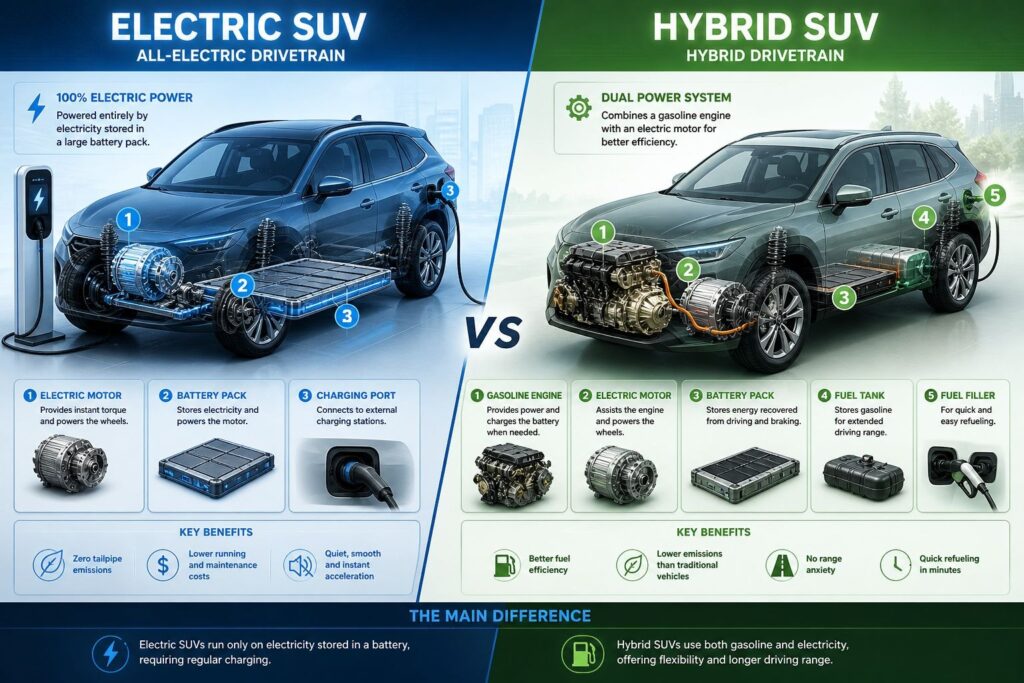
Electric SUVs rely solely on large battery packs and electric motors, while hybrid SUVs combine a gasoline engine with one or more electric motors. This distinction creates very different ownership experiences, infrastructure requirements, and performance profiles.
How do electric SUVs work?
An electric SUV runs entirely on electricity stored in a large battery pack, typically mounted beneath the passenger cabin floor. When the driver accelerates, the electric motor draws power from this battery and converts it directly into torque to drive the wheels.
This process produces zero tailpipe emissions, making the largest electric SUV models some of the cleanest vehicles currently available on the market. Modern electric vehicles also use regenerative braking to recover energy during deceleration, which improves efficiency and extends driving range.
The battery recharges by plugging the vehicle into either a home charging station or a public charging network. Level 2 home chargers, which require a dedicated 240-volt electrical circuit, deliver the fastest and most convenient home charging experience.
How do hybrid SUVs work?
A hybrid SUV uses both a gasoline engine and an electric motor working together to power the vehicle. The two systems operate collaboratively: the electric motor handles low-speed city driving, while the gasoline engine takes over at higher speeds or when more power is needed.
This combination reduces fuel consumption significantly compared to a traditional gasoline-only SUV, making fuel-efficient hybrid SUVs especially practical for mixed-use drivers. There are different types of hybrids, including standard hybrids and plug-in hybrids, where PHEV means Plug-in Hybrid Electric Vehicle.
A common question buyers ask is, “Do you have to plug in a hybrid car?” The answer depends on the type. Traditional HEVs charge their batteries through regenerative braking and the engine itself, requiring no external plug. PHEVs, however, require external charging to maximize their electric range.
Charging vs Refueling: Time, Access, and Convenience
One of the most immediate lifestyle differences between electric and hybrid SUVs involves how drivers use up their vehicle’s energy. Hybrid SUV owners refuel at any gas station in minutes, just like traditional vehicle owners.
Electric SUV drivers, however, must plan their charging around station availability, charge times, and home charging infrastructure. This practical difference significantly influences which option works best for each driver’s daily routine.
Home charging is a major advantage for electric SUV owners who can install a Level 2 charger in their garage. These drivers effectively wake up every morning with a full charge, similar to charging a smartphone overnight.
However, those without private parking or home charging access face genuine inconvenience. Public fast-charging networks have expanded rapidly in 2026, but coverage gaps still exist in rural and suburban areas, making hybrid SUVs a more practical choice for those drivers.
Hybrid SUV drivers enjoy complete refueling flexibility since every gas station in the country supports them. PHEV owners also benefit from the option to plug in at home for short-trip electric driving while maintaining the ability to refuel with gasoline for longer journeys.
This flexibility removes range anxiety entirely and makes hybrid SUVs genuinely practical for any driver, regardless of location, commuting patterns, or access to charging infrastructure. This makes hybrids more convenient in regions where charging infrastructure remains limited or inconsistent.
Cost Comparison Beyond the Purchase Price
The sticker price of a vehicle tells only part of the story. A thorough cost comparison between electric and hybrid SUVs must account for fuel savings, maintenance differences, insurance rates, government incentives, and infrastructure investment.
If you focus only on the upfront cost, you often overlook thousands of dollars in long-term savings or expenses. Understanding the total cost of ownership changes the calculus significantly for both powertrain types.

Upfront Cost Differences
Electric SUVs generally carry a higher purchase price than comparable hybrid models. In 2026, a well-equipped electric SUV from a mainstream brand typically starts between $45,000 and $65,000, while larger flagship models can exceed $90,000.
Hybrid SUVs, by contrast, start at more accessible price points, generally ranging from $35,000 to $55,000 for well-featured models. PHEVs tend to cost slightly more than standard HEVs because they incorporate a larger battery and a more complex charging system.
Running and Maintenance Costs
Electric SUVs deliver outstanding savings on both fuel and maintenance over their lifetime. Electricity is consistently cheaper per mile than gasoline, and because EVs have fewer mechanical components, they require far less servicing. There are no oil changes, no timing belt replacements, no spark plug services, and no exhaust system repairs.
Hybrid SUVs also generate meaningful fuel savings compared to pure gasoline vehicles, but their dual-system architecture introduces additional maintenance complexity. Owners must service both the gasoline engine and the electric drivetrain components over time.
Hidden Costs to Consider
Electric SUV buyers often underestimate the cost of installing a home charging station. A Level 2 charger unit itself typically costs between $300 and $800, but professional installation, including any necessary electrical panel upgrades, can push the total to $1,500 or even $2,000 in older homes.
Hybrid SUV buyers face their own set of hidden costs. The dual powertrain system containing both a gasoline engine and an electric motor means more components that can potentially fail or require servicing over time. Furthermore, PHEV battery degradation, while slower than in pure EVs, does occur and may eventually require a costly replacement.
Range and Practical Usability
Range is one of the most frequently discussed factors in the electric SUVs vs. hybrid SUVs debate. How far a vehicle can travel on a single charge or tank of fuel directly determines its practical usability for different drivers. Range requirements vary enormously depending on whether a driver commutes 15 miles daily in a city or regularly makes 400 miles on long trips.

Modern electric vehicles have made extraordinary progress on range. Many new electric SUV models now deliver between 250 and 400 miles on a full charge under favorable conditions. Hybrid SUVs sidestep this concern entirely by combining electric and gasoline power for a combined range that typically exceeds 500 miles between fill-ups.
Real-World Driving Range
Advertised range figures for electric SUVs often reflect ideal testing conditions that do not match everyday driving realities. In cold climates, battery range can drop by 20 to 40 percent, significantly affecting planned trips. At sustained highway speeds above 70 mph, range also decreases noticeably compared to city driving.
The best hybrid SUV models typically achieve 35 to 45 miles per gallon in combined city and highway driving, translating to real-world ranges of 500 miles or more per tank. PHEVs add an additional 25 to 50 miles of electric-only driving at the start of each trip, allowing short commuters to operate almost entirely on electricity.
Range Anxiety vs Fuel Flexibility
Range anxiety, the fear of running out of battery power before reaching a charger, remains a real psychological barrier for many prospective electric SUV buyers. While significant infrastructure investment has reduced this concern in urban and suburban areas, it persists for drivers in rural regions or those who frequently travel between cities.
Hybrid SUVs completely eliminate range anxiety by design. A PHEV driver who runs low on electric charge simply switches to gasoline, maintaining the ability to refuel at any of the hundreds of thousands of gas stations nationwide. This flexibility makes a fuel-efficient hybrid SUV the pragmatic choice for anyone who values freedom.
Maintenance, Reliability, and Lifespan
Long-term reliability and maintenance requirements represent one of the most significant practical differences between electric and hybrid SUVs. Electric SUVs, with their simpler mechanical architecture, generally require far less routine maintenance than any combustion-based vehicle.
There are no engine oil changes, no timing belt services, no fuel injector cleanings, and no exhaust system repairs. This simplicity directly contributes to lower annual maintenance costs and fewer unexpected service visits over the vehicle’s lifetime.
Hybrid SUVs, while more fuel-efficient than gasoline-only vehicles, introduce additional complexity through their dual powertrain system. Maintaining both a gasoline engine and an electric motor requires attention to two separate sets of components.
Battery lifespan is a critical factor in the long-term value of both vehicle types. Electric SUV batteries typically carry warranties of 8 years or 100,000 miles, with many modern units performing well beyond this threshold.
Environmental Impact: How Green Are They Really?
Environmental impact is a central motivation for many buyers choosing between electric and hybrid SUVs. On the surface, electric SUVs appear to hold a clear environmental advantage; zero tailpipe emissions mean no direct air pollution from driving.
In regions where the electrical grid relies heavily on renewable sources like wind, solar, or hydroelectric power, electric SUVs deliver dramatically lower lifecycle carbon emissions than any hybrid alternative. However, in areas where electricity predominantly comes from coal or natural gas plants, the carbon advantage of electric SUVs narrows considerably.
Hybrid SUVs reduce emissions compared to pure gasoline vehicles but do not eliminate them. A PHEV driven primarily on electricity for short trips produces minimal direct emissions, approaching EV-level cleanliness in daily use. However, on longer trips relying on the gasoline engine, emissions increase substantially.
Battery manufacturing for both vehicle types carries an environmental cost in terms of mining lithium, cobalt, and other materials, a factor that both industries continue to address through improved recycling programs and more sustainable sourcing practices
Resale Value and Market Trends
Resale value is a critical factor that savvy vehicle buyers carefully evaluate before making a purchase. The used market for both electric and hybrid SUVs has matured significantly by 2026, giving buyers more reliable data on depreciation trends.
Electric SUVs from premium brands like Tesla have historically retained strong resale values due to high demand and brand loyalty. However, rapid model iteration and improving battery technology mean that older EV models can depreciate quickly when newer, longer-range alternatives enter the market.

Hybrid SUVs from established brands, particularly Toyota and Honda, have consistently demonstrated strong resale value retention. The proven reliability record of these vehicles, combined with broad consumer acceptance and minimal maintenance concerns, makes them reliable performers on the used market.
Market trends strongly favor continued growth in both segments. Government mandates, corporate sustainability commitments, and rising consumer environmental awareness all drive demand for electrified vehicles.
However, the rate of EV adoption has been uneven across regions, and buyers in markets with limited charging infrastructure may find stronger demand for PHEVs and HEVs on the secondary market.
Common Buying Mistakes to Avoid
Many buyers make costly mistakes when purchasing either an electric or hybrid SUV, often due to incomplete research or unrealistic expectations. Knowing these pitfalls in advance allows buyers to approach their purchase with clarity and confidence.
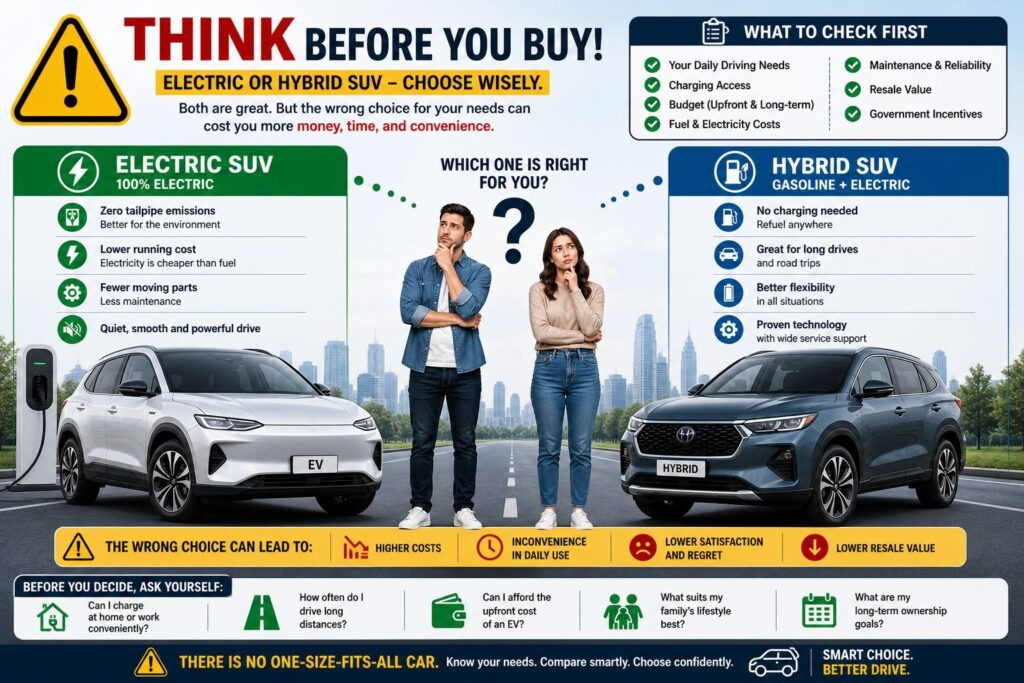
Avoid these critical mistakes when evaluating hybrid vs. EV cars:
- Ignoring charging infrastructure in your area: Research public charging availability and home charger installation feasibility before committing to a pure electric SUV.
- Focusing only on the sticker price: The upfront cost is only one factor. Calculate the total 5-year ownership cost, including fuel, maintenance, insurance, and incentives.
- Overestimating daily range needs: Most drivers cover fewer than 50 miles per day, which both EVs and PHEVs handle comfortably. Do not pay a premium for 400-mile range if it is unnecessary.
- Neglecting battery warranty terms: Confirm the battery warranty coverage period and what it covers before purchasing. Avoid vehicles with limited or unclear battery replacement policies.
- Assuming all hybrids are the same: MHEV, HEV, and PHEV systems perform very differently. Understand which type a specific model uses before making comparisons.
- Skipping a test drive in real conditions: Always test drive a vehicle in conditions that mirror actual daily use, highway speed, uphill grades, or cold weather if applicable.
- Overlooking government incentive eligibility: Not all buyers qualify for the full federal tax credit. Check income limits, vehicle price caps, and assembly origin requirements before assuming the incentive applies.
- Underestimating long-trip planning for EVs: If road trips are frequent, map out charging stop availability along common routes before purchasing a pure electric SUV.
Is hybrid better than an electric SUV?
In short, an electric vehicle generally offers better performance, better efficiency, unique features, and a better driving experience than a plug-in hybrid. However, the long answer as to which is best for you depends on how and where you intend to use it.
What is better, a hybrid or an electric vehicle?
A hybrid is better for flexibility and long-distance driving with easy refueling, while an electric vehicle is better for lower running costs and zero emissions if you have reliable charging access.
What are the disadvantages of a hybrid electric vehicle?
Hybrid electric vehicles have a few key disadvantages, including higher mechanical complexity due to having both an engine and electric system, which can lead to more costly repairs; they still rely on gasoline, so they don’t fully eliminate fuel costs or emissions; and they often have smaller batteries, meaning limited electric-only driving compared to full electric vehicles.
Conclusion
The question of electric SUVs vs. hybrid SUVs in 2026 does not have a universal answer; it has the right answer for each individual driver. Electric SUVs deliver superior environmental performance, lower long-term running costs, and a cutting-edge driving experience that continues to improve with each model year.
Hybrid SUVs, however, remain the smarter choice for drivers who travel long distances regularly, lack reliable home charging access, or prioritize flexibility above all else. The best hybrid SUV models in 2026 combine proven reliability, genuine fuel efficiency, and the freedom to refuel anywhere.

The electric SUV market has never been more competitive, and the Honda Prologue vs Rivian R2 matchup stands out as one of the most talked-about comparisons of 2026. Both vehicles target buyers who want a capable, tech-forward, longest-range EV without compromising on everyday practicality.
Understanding what separates these two electric SUVs requires looking beyond the spec sheet. The Honda Prologue brings the reliability and familiarity of a mainstream automaker into the EV space, offering a refined cabin, broad charging network access, and an EPA-estimated range of up to 308 miles.
On the other hand, the Rivian R2 enters as an adventure-ready challenger with serious off-road credentials, a bold design, and a top-trim range of up to 345 miles. These numbers place it among the longest-range EV options in its segment.
Quick Comparison: Honda Prologue vs Rivian R2
Before diving into individual sections, it helps to understand where these two vehicles land side by side. The Honda Prologue and Rivian R2 share a similar footprint and price bracket, yet their personalities are entirely different.
The Prologue prioritizes comfort and accessibility, while the R2 emphasizes performance, technology, and trail capability. Furthermore, their ownership experiences diverge significantly once the buyer considers charging infrastructure, software updates, and long-term support.
The Rivian R2 launches with its performance trim in spring, estimated at $57,990, with the more accessible standard in the upcoming year at around $48,490. The Honda Prologue starts at $47,400 for the EX FWD trim, making it the more immediately affordable choice. However, both vehicles target buyers willing to invest in premium electric mobility.
Key Specs Overview Table
| Feature | Honda Prologue | Rivian R2 |
| Starting Price | $47,400 | $57,990 |
| Horsepower | 300 hp | 656 hp |
| Torque | 355 lb-ft | 690 lb-ft |
| 0–60 mph | Around 6 sec (AWD) | 3.6 sec |
| EPA Range | 308 miles (FWD) | 330 miles (AWD) / 345 miles (RWD) |
| Battery | 85 kWh | 87.9 kWh |
| DC Fast Charge Speed | Up to 155 kW | Up to 10–80% in 29 min |
| Towing Capacity | 1,500 lbs | 4,400 lbs (w/ tow package) |
| Ground Clearance | Standard | 9.6 inches |
| Seating | 5 passengers | 5 passengers |
| Charging Port | NACS + CCS | NACS |
| Drive Modes | Standard | 8 modes (Rally, Sand, Snow, etc.) |
Design and Exterior Differences
Design plays a decisive role when a buyer evaluates the Honda Prologue vs Rivian R2, because these two vehicles express completely different philosophies about what an electric SUV should look like.

The Prologue leans into a clean, neo-rugged aesthetic built with virtual reality design tools, while the R2 takes cues from Rivian’s larger R1S and delivers a bold, blocky silhouette that immediately signals off-road intent.
Both vehicles share upright proportions and a confident stance, but the similarity ends there. The Prologue blends into mainstream crossover styling in a way that appeals to buyers who prefer understated elegance.
Whereas the Rivian R2 turns heads with its signature oval headlights, flush door handles, and retractable rear drop glass. Consequently, the choice between these two is as much about personal expression as it is about engineering.
Honda Prologue Design Highlights
The Honda Prologue carries a distinctly neo-rugged design language that Honda engineers developed using advanced virtual reality tools, a process that reflects careful attention to proportion, aerodynamics, and visual cohesion.
Its upright body lines, available 21-inch alloy wheels (the largest ever offered on a Honda), and character lines that hint at performance give it a premium appearance that fits naturally in both urban and suburban environments. Moreover, this design approach makes it one of the most visually accessible electric crossovers available today.
Rivian R2 Design Highlights
The Rivian R2 design takes direct inspiration from the larger R1S, delivering a slab-sided, muscular exterior with remarkably few creases or unnecessary flourishes. Its most recognizable features include vertically oriented oval headlights connected by a horizontal light bar, flush pop-out door handles, and integrated tow hooks.
It also has a rear drop glass that powers lower into the liftgate, a feature Rivian borrowed from classic SUV design. The R2 is available in the exclusive Rivian Storm Blue colorway as part of its Launch Package, which has already become a signature identifier for early adopters.
Performance and Driving Experience
The Prologue delivers smooth, predictable performance perfectly suited to highway cruising and city commuting, while the R2 Performance trim delivers supercar-adjacent acceleration in an SUV body.
In short, these two vehicles serve genuinely different performance demands. The Honda Prologue AWD produces 300 horsepower and 355 lb-ft of torque, delivering a comfortable 0 to 60 mph sprint that satisfies most buyers without ever feeling aggressive.

The Rivian R2 Performance, however, generates 656 horsepower and 690 lb-ft of torque, launching from 0 to 60 mph in just 3.6 seconds, a figure that puts it firmly in performance-vehicle territory.
Acceleration and Power
Even the R2 Premium, which arrives later at an estimated price of $53,990, delivers 450 horsepower and a 4.6-second sprint, still significantly quicker than the Prologue’s dual-motor configuration. Therefore, if you are performance-focused, then you have a clear answer when comparing these two vehicles directly.
Its single-motor FWD variant outputs 220 horsepower, which serves everyday driving well but will feel modest next to the Rivian’s performance figures. Nevertheless, the Prologue’s tuned suspension and balanced weight distribution give it a natural fluidity on winding roads that many drivers will appreciate over raw acceleration numbers.
City vs Off-Road Capability
In urban environments, the Honda Prologue demonstrates exactly why mainstream buyers gravitate toward it. Its composed ride, tight turning radius, and standard Honda Sensing safety suite make city driving effortless and reassuring. Its 1,500-pound towing capacity limits hauling capability, but most urban and suburban drivers will never push beyond that threshold.
The Rivian R2 raises the off-road bar for compact electric SUVs dramatically, with 9.6 inches of ground clearance, eight selectable drive modes (including Soft Sand, Rally, and Snow), and an all-terrain wheel option that few competitors can match at this size. Its dual-motor AWD system includes an all-terrain drive mode and semi-active suspension on the performance trim.
Interior, Tech and Infotainment
Inside, the Honda Prologue vs Rivian R2 comparison reveals two very different philosophies about cabin design, technology integration, and the driver’s relationship with their vehicle. The Prologue prioritizes familiarity and refinement through a clean, premium layout that Honda enthusiasts will immediately understand.

The Rivian R2, meanwhile, delivers a tech-forward cockpit designed around a large central touchscreen, AI-driven voice control, and a modular storage philosophy. Both approaches work well, but they serve different types of owners.
Cabin Quality and Space
The Honda Prologue cabin reflects its Chevrolet Blazer EV underpinning with a clean, upscale interior featuring an 11.3-inch HD touchscreen with Google built-in, an 11-inch digital instrument cluster, wireless Apple CarPlay and Android Auto, and available heated and ventilated seats.
The Rivian R2 interior centers around ease of use and adventure-ready utility, with a large center-mounted touchscreen handling infotainment, climate, and vehicle settings. Notably, the R2 does not support Apple CarPlay or Android Auto, a decision Rivian made to maintain full control over its software ecosystem and deliver consistent over-the-air updates.
Safety and Driver Assistance Features
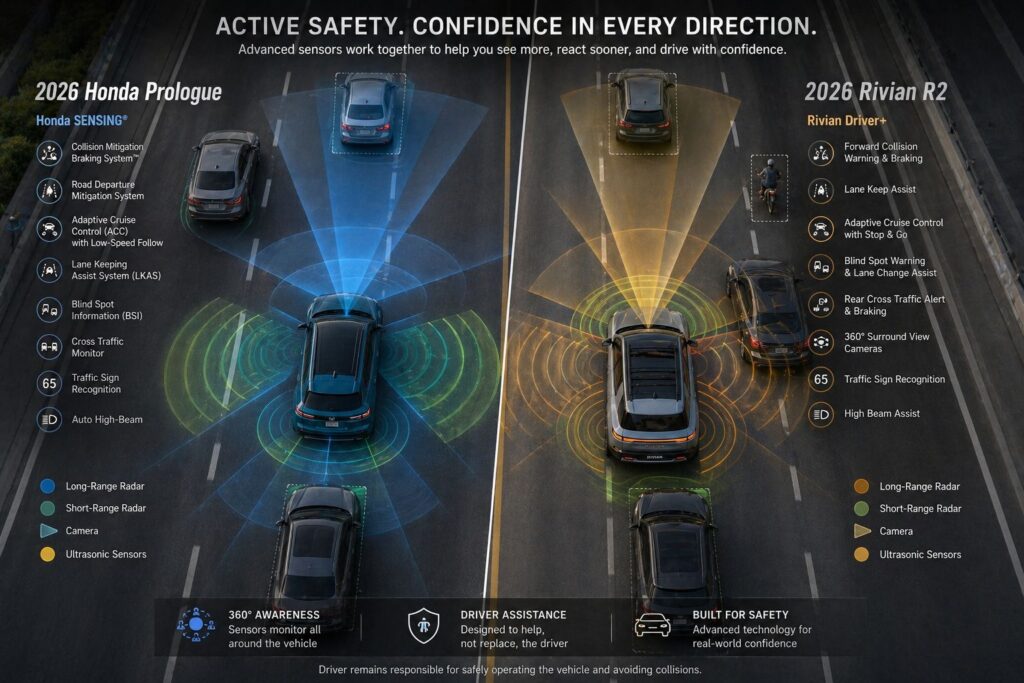
Every Honda Prologue comes standard with Honda Sensing, a comprehensive suite that includes rear cross-traffic braking, blind-zone steering assist, rear pedestrian alert, adaptive cruise control, lane keeping assist, and traffic sign recognition.
The Rivian R2 matches and extends this safety foundation with 11 HDR cameras, a five-radar system, forward collision warning, automatic emergency braking, and a surround-view camera. Its optional Rivian Autonomy+ system adds Level 2 hands-free driving on 3.5 million miles of scanned roads in the US and Canada.
Battery, Range and Charging
Range anxiety remains a primary concern for electric vehicle buyers, and the Honda Prologue vs Rivian R2 comparison delivers encouraging news for both camps. Both vehicles carry approximately 85 to 88 kWh battery packs and achieve over 300 miles of real-world range in their best configurations, placing them firmly among the longest-range EVs.

The question of how long it takes to charge an electric car depends heavily on the charger type and the vehicle’s onboard charging hardware. Both the Prologue and R2 support DC fast charging, which dramatically reduces charge times compared to a standard Level 2 charger at home.
Real-World Range Comparison
The Honda Prologue delivers an EPA-estimated range of 308 miles for EX and Touring FWD trims, dropping to 294 miles for AWD configurations and 283 miles for the Elite AWD with larger wheels. These numbers place the Prologue comfortably within range of most buyers’ weekly and weekend driving needs without requiring frequent charging stops.

The Rivian R2 Standard RWD Long Range achieves the segment-leading figure of 345 miles of estimated range, while the Performance and Premium AWD trims deliver a still-impressive 330 miles. This makes the R2 one of the closest competitors to the longest-range EV options currently available under $60,000.
Charging Speed
The Honda Prologue supports DC fast charging at rates up to 155 kW, which adds approximately 65 miles of range in just 10 minutes, a competitive figure for buyers who charge on public networks regularly.
Using a standard Level 2 charger at home, the Prologue accepts up to 11.5 kW through its available Home Charging Station package, which Honda includes as part of the vehicle purchase along with a portable 7.6 kW charging kit as standard equipment.
The Rivian R2 charges from 10% to 80% in approximately 29 minutes on a compatible DC fast charger, a figure Rivian describes as optimal-condition performance. Its NACS port ensures compatibility with the growing Tesla Supercharger network and all major public charging providers adopting the standard.
Pros and Cons
Honda Prologue: Pros and Cons
Buyers often ask whether the Honda Prologue is a good car, and the answer is a nuanced yes; it excels in areas where Honda has always been strong, but it carries limitations that reflect its origins as a transitional product. Understanding both sides helps prospective buyers set realistic expectations before visiting a dealership.
There are some advantages of the Honda Prologue:
- Up to 308 miles of EPA-estimated range for maximum FWD efficiency
- Standard Honda Sensing safety suite on every trim
- Broad charging network access, including Tesla Supercharger compatibility
- Google built-in infotainment with wireless CarPlay and Android Auto
- Available panoramic moonroof and premium interior finishes
- Competitive starting estimated price at $47,400 with included charging equipment
There are some limitations of the Honda Prologue:
- Built on Chevrolet Blazer EV platform, not a native Honda EV architecture
- Modest 1,500-pound towing capacity limits hauling versatility
- No performance-oriented driving modes or off-road capability
- AWD range drops to 294 miles compared to FWD’s 308 miles
- Limited driving excitement, tuned for comfort, not engagement
- May be discontinued once Honda’s 0 Series EVs arrive
Rivian R2: Pros and Cons
The Rivian R2 arrives as one of the most anticipated electric SUV launches in recent years, and its specification list justifies the excitement. However, its staggered trim rollout, early-launch pricing, and first-generation platform introduce genuine considerations that buyers must weigh carefully before committing.
There are some advantages of the Rivian R2:
- Class-leading 345 miles of estimated range (RWD Long Range trim)
- Extraordinary performance, up to 656 hp and 3.6-second 0 to 60 time
- 9.6 inches of ground clearance with genuine off-road capability
- Eight selectable drive modes including Rally, Soft Sand, and Snow
- 4,400-pound towing capacity with tow package
- AI-powered voice assistant with Rivian Autonomy+ Level 2 hands-free driving
- Rivian Storm Blue and exclusive Launch Package options for early adopters
There are also some drawbacks of R2:
- The first available trim (Performance) starts at $57,990, well above base price
- No Apple CarPlay or Android Auto support
- No heat pump on launch package vehicles impacts cold-weather range
- Affordable $45,000 Standard trim not available until late 2027
- First-generation platforms carry inherent software and service uncertainty
- Service network less established than Honda’s nationwide dealer footprint
Is the Honda Prologue a good EV?
With a range of 300+ miles and smart charging options like access to over 23,000 Tesla Supercharger ports, the Honda Prologue sets the standard for electric vehicles. It has a high-tech, comfortable interior with built-in Google, 57 square feet of cargo space, and powerful all-wheel drive performance with 300 horsepower.
How big is the Rivian R2 compared to the Honda CRV?
The new Rivian R2 is a midsize electric SUV that is 185.5 to 185.8 inches long. This makes it almost the same size as a new Honda CR-V, which is 184.7 inches long.
What is special about Rivian R2?
The thing that makes the R2 special is its well-organized and well-performed suspension. With the ability to adjust it as you needed. This makes the handling of the vehicle more responsive and smooth even at high speed.
Why are Honda prologues not selling?
The main reason to consider dropping the sales of the Prologue is its decreasing production by half. Another reason is its eliminated tax credits; because of this, the sales of Prologue have decreased.
Conclusion
The Honda Prologue vs Rivian R2 comparison ultimately reveals two outstanding electric SUVs that serve different masters exceptionally well. For buyers who value refinement, brand trust, immediate affordability, and broad charging infrastructure, the Honda Prologue delivers everything needed for a confident switch to electric driving.
For buyers who demand performance, adventure capability, and cutting-edge technology, the Rivian R2 redefines what a compact electric SUV can accomplish. Its 345-mile Rivian R2 range, 656-horsepower Performance trim, AI-powered autonomy features, and genuine off-road geometry make it the most exciting EV launch in its segment this year.

Electric SUVs are rapidly transforming the global automotive market, offering a cleaner and more efficient alternative to traditional fuel-powered vehicles. Among the most talked-about models today are the BYD Atto 3 vs MG ZS EV, both competing in the affordable electric SUV segment.
As fuel prices rise and environmental awareness increases, more buyers are considering electric vehicles for daily use. However, choosing the right EV can be challenging, especially when comparing two strong contenders with similar pricing and features.
This comparison explores key aspects such as design, performance, battery range, charging, and overall value. By analyzing real-world usability and ownership factors, readers can better understand which EV suits their lifestyle.
BYD Atto 3 vs MG ZS EV: Quick Overview
Both the BYD Atto 3 and MG ZS EV are compact electric SUVs designed for modern drivers seeking efficiency and affordability. While they share similarities, each vehicle targets a slightly different audience based on features and driving experience.
The BYD Atto 3 focuses on innovation, offering advanced battery technology and a futuristic interior. In contrast, the MG ZS EV emphasizes practicality, affordability, and a well-established service network, making it a safer choice for many buyers.

BYD Atto 3 Overview
The BYD Atto 3 is a relatively new entrant in many markets, yet it has quickly gained attention due to its modern design and strong performance. It features BYD’s Blade Battery technology, which enhances safety and efficiency.
Additionally, the SUV offers a premium cabin experience with unique design elements and advanced infotainment features. This makes it appealing to tech-savvy buyers who want something different from traditional vehicles.
Moreover, the Atto 3 provides a higher driving range compared to many competitors, making it suitable for both city and highway use. This combination of range and innovation gives it a competitive edge.
MG ZS EV Overview
The MG ZS EV has been available longer and has built a solid reputation in the electric vehicle market. It is known for its affordability and reliability, making it a popular choice among first-time EV buyers. Furthermore, the SUV offers a simple and user-friendly interior with practical features.
Unlike the BYD, it focuses more on ease of use rather than flashy design elements. In addition, MG benefits from a wider service network and better availability in many regions. This makes it a convenient option for buyers concerned about maintenance and support.
Design and Interior Experience
The design approach of both vehicles highlights their target audiences. The BYD Atto 3 adopts a bold and futuristic design, while the MG ZS EV maintains a conventional and familiar SUV look.
Inside the cabin, the difference becomes even more noticeable. The Atto 3 delivers a tech-focused and visually engaging interior, whereas the MG prioritizes simplicity and functionality for everyday use.

Key Interior Difference
The BYD Atto 3 features a unique cabin design with elements like a rotating touchscreen and creative styling details. These features create a modern and premium atmosphere that stands out in the segment.
On the other hand, the MG ZS EV offers a more traditional layout with physical controls and a straightforward interface. This makes it easier for users who prefer a familiar driving experience. Ultimately, the choice depends on preference. Buyers seeking innovation may prefer BYD, while those valuing simplicity may lean toward MG.
Space, Comfort and Practical Usability
Space and practicality are key decision factors when comparing compact electric SUVs, especially for families and daily commuters. In the BYD Atto 3 vs MG ZS EV comparison, both vehicles offer well-designed cabins, but they differ in how they utilize interior space and comfort features.

The BYD Atto 3 provides a more spacious and airy cabin due to its longer wheelbase and flat floor design. Meanwhile, the MG ZS EV focuses on functional practicality, offering smart storage solutions and a layout that is easy to use for everyday driving needs.
| Feature | BYD Atto 3 | MG ZS EV |
| Boot Space | Approximately 430+ L | Approximately 350+ L |
| Cabin Space | More open and airy | Slightly compact but practical |
| Rear Seat Comfort | Better legroom and flat floor | Good, but less spacious |
| Storage Options | Hidden compartments + modern layout | More traditional storage spaces |
| Tailgate | electric (automatic) | Manual |
There are some key insights:
- The BYD Atto 3 is better for families and long trips due to extra rear space and comfort features.
- MG ZS EV is more practical for daily city use with easier loading and simple layout.
- BYD offers a premium feel, while MG focuses on functional usability.
Although the BYD Atto 3 has a larger boot capacity on paper, the MG ZS EV’s lower boot floor makes it easier to load bulky items. This is a small but important real-world usability factor many buyers overlook.
Battery, Range and Efficiency
Battery performance is one of the most critical factors when comparing electric SUVs, as it directly impacts usability, running cost, and long-term ownership experience. In the BYD Atto 3 vs MG ZS EV comparison, both vehicles offer reliable electric powertrains, but they differ significantly in battery technology and real-world range.
The BYD Atto 3 stands out with its advanced Blade Battery, which focuses on safety, efficiency, and longevity. In contrast, the MG ZS EV offers multiple battery options with decent efficiency, making it a practical choice for city driving, but slightly less capable for long-distance travel.

BYD Atto 3 Range
The BYD Atto 3 delivers a strong range of approximately 420 to 480 km depending on driving conditions, making it one of the most competitive options in the affordable EV SUV segment. This extended range allows drivers to comfortably handle both daily commutes and intercity journeys without frequent charging stops.
Additionally, the vehicle uses BYD’s Blade Battery technology, which is known for enhanced safety and thermal stability. Unlike traditional lithium-ion batteries, this design reduces the risk of overheating while improving space efficiency within the vehicle.
Moreover, the Atto 3 maintains better range consistency in real-world conditions such as highway driving and moderate climate changes. As a result, it significantly reduces range anxiety, especially in regions where charging infrastructure is still developing.
MG ZS EV Range
The MG ZS EV offers a practical driving range of around 320 to 350 km, which is sufficient for most daily urban and suburban use cases. It is designed to deliver consistent performance for short commutes, office travel, and city errands.
Furthermore, MG provides different battery configurations in some markets, allowing buyers to choose between standard and long-range variants. This flexibility makes it appealing to budget-conscious users who want an entry-level electric SUV.
However, in real-world conditions such as highway speeds or heavy AC usage, the range can drop more noticeably compared to the BYD Atto 3. Therefore, drivers may need to plan charging stops more carefully during longer trips.
| Feature | BYD Atto 3 | MG ZS EV |
| Battery Type | Blade Battery (LFP) | Lithium-ion |
| Range | Approximate 420 to 480 km | Approximate 320 to 350 km |
| Efficiency | Higher | Moderate |
| Long-Distance Suitability | Excellent | Limited |
| Range Stability | More consistent | Varies with usage |
Range is not just about numbers. Real-world efficiency depends on driving habits, climate, and road conditions. In this case, the BYD Atto 3 performs more consistently, which makes it a safer choice for buyers concerned about unpredictable range drops.
Charging Experience in BYD Atto 3 vs MG ZS EV
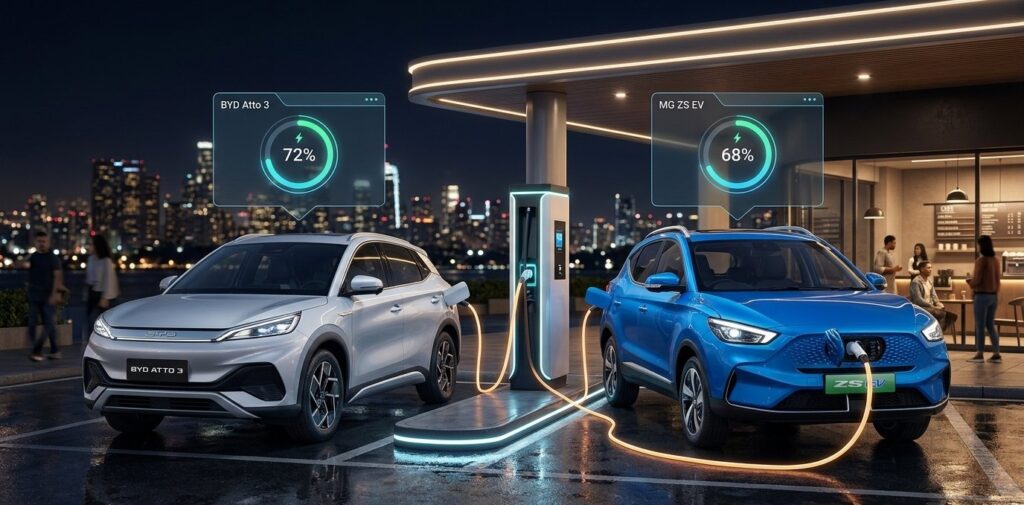
Charging experience is a crucial factor in electric vehicle ownership, as it directly affects convenience, travel planning, and overall usability. In the BYD Atto 3 vs MG ZS EV comparison, both SUVs support modern charging standards, including DC fast charging and home charging, making them practical for everyday use.
However, differences in charging speed, battery management, and additional features create a noticeable gap between the two. The BYD Atto 3 offers slightly faster charging performance and advanced capabilities, while the MG ZS EV focuses on reliability and compatibility with existing charging infrastructure.
BYD Atto 3 Charging Experience
The BYD Atto 3 supports up to 80 kW DC fast charging, allowing it to recharge from around 30% to 80% in approximately 30 to 45 minutes. This makes it highly efficient for quick stops during long trips, especially on highways.
Additionally, the Atto 3 includes Vehicle-to-Load (V2L) functionality, enabling users to power external devices such as laptops, appliances, or camping equipment. This feature adds versatility beyond standard driving use.
MG ZS EV Charging Experience
The MG ZS EV supports DC fast charging up to 50 kW, which allows it to reach around 80% charge in approximately 50 to 60 minutes. While slightly slower than BYD, it still provides a practical solution for most users.
Furthermore, the vehicle performs well with AC charging, especially in home setups with higher-capacity chargers. This makes overnight charging simple and efficient for daily commuting needs.
Performance Comparison
Performance plays a crucial role in defining the overall driving experience of an electric SUV, especially when comparing two strong contenders like BYD and MG. In the BYD Atto 3 vs MG ZS EV comparison, both vehicles offer smooth and quiet electric driving.
The BYD Atto 3 is engineered to deliver a more engaging and dynamic driving experience, while the MG ZS EV focuses on comfort and ease of driving. This difference becomes more noticeable during acceleration, highway driving, and handling in different road conditions.

BYD Atto 3 Driving Feel
The BYD Atto 3 delivers a more powerful performance with approximately 201 horsepower and 310 Nm of torque, which gives it a clear advantage in acceleration. It can go from 0 to 100 km/h in around 7.3 seconds, making it feel quick and responsive, especially in urban traffic and overtaking scenarios.
Additionally, the instant torque delivery typical of electric vehicles is more noticeable in the Atto 3. This results in a punchy and energetic driving feel, particularly when switching to sport mode. Drivers can easily merge into highways or overtake slower vehicles with confidence.
MG ZS EV Driving Feel
The MG ZS EV offers a more relaxed and comfort-focused driving experience, with around 174 horsepower and 280 Nm of torque. While slightly less powerful than the BYD, it still provides smooth and adequate acceleration for daily driving needs.
Furthermore, the MG prioritizes ride comfort over sporty handling. Its softer suspension absorbs road bumps effectively, which is especially useful on uneven city roads. This makes it a better choice for users who value comfort during daily commutes.
Technology Features
Technology is one of the biggest differentiators in the BYD Atto 3 vs MG ZS EV comparison, as modern buyers expect advanced infotainment, connectivity, and driver assistance features in electric SUVs. Both vehicles offer a solid tech package, but their approach is quite different in terms of innovation and usability.

BYD Atto 3 Technology Features
The BYD Atto 3 stands out with its rotating 12.8-inch infotainment screen, which can switch between portrait and landscape modes. This unique feature enhances usability and gives the cabin a modern, high-tech feel compared to traditional systems.
Additionally, the vehicle includes advanced voice control, allowing drivers to manage functions like climate control, navigation, and media without taking their hands off the wheel. This improves safety and convenience during driving.
MG ZS EV Technology Features
The MG ZS EV focuses on practical and user-friendly technology, making it easy for drivers to adapt quickly. It features a 10.1-inch touchscreen infotainment system with Apple CarPlay and Android Auto support, ensuring seamless smartphone integration.
Furthermore, the interface is simple and intuitive, which is ideal for users who prefer straightforward controls. Physical buttons are still present, making it easier to operate key functions without navigating complex menus.
Safety and Build Quality
Safety remains a top priority for EV buyers, especially when choosing a family-friendly SUV. In the BYD Atto 3 vs MG ZS EV comparison, both vehicles come equipped with modern safety features and solid build quality, ensuring protection for passengers.
The BYD Atto 3 is built on a dedicated EV platform, which enhances structural rigidity and crash protection. It also includes multiple airbags, electronic stability control, and advanced driver assistance systems for improved safety.
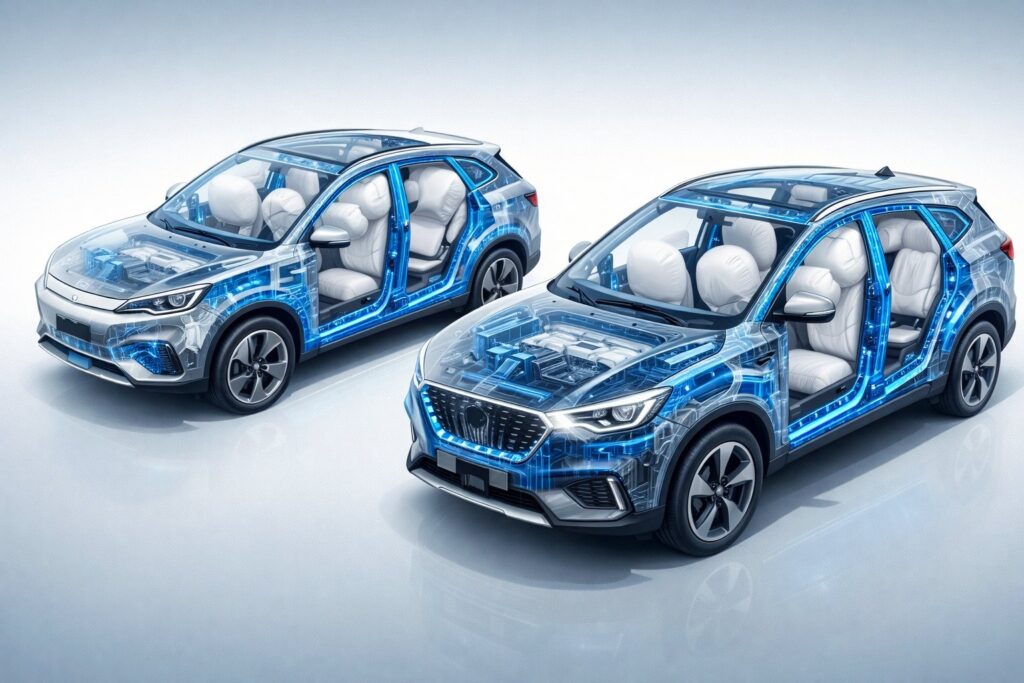
Additionally, the blade battery not only improves efficiency but also enhances safety by reducing the risk of thermal runaway. This makes it one of the safer battery technologies in the EV market. Newer safety updates and crash test improvements have strengthened BYD’s position. The vehicle now offers a competitive level of safety that aligns with global standards.
The MG ZS EV benefits from a proven safety record, including strong crash test ratings in several markets. This gives buyers added confidence, especially those prioritizing reliability and established performance.
In addition, MG’s build quality focuses on durability and consistency. While it may not be as advanced as BYD in some areas, it delivers dependable safety performance backed by years of market presence.
Which One Should You Buy?
Choosing between the BYD Atto 3 vs MG ZS EV ultimately depends on your driving needs, budget, and expectations from an electric SUV. Both vehicles offer strong value in their segment, but they target slightly different types of buyers.

The BYD Atto 3 positions itself as a future-ready, performance-oriented electric SUV, while the MG ZS EV focuses on affordability, practicality, and reliability. Understanding these differences will help buyers make a confident and informed decision.
The BYD Atto 3 is ideal for you if you want a modern and future-focused EV experience. Its longer range and faster charging make it more suitable for highway travel and intercity driving, reducing range anxiety significantly.
The MG ZS EV is a practical option for you if you prioritize budget, reliability, and ease of ownership. Its lower price makes it more accessible, especially for first-time EV buyers. Furthermore, the established service network and better parts availability provide peace of mind, particularly in regions where EV infrastructure is still developing.
Which one is better, MG or BYD?
BYD offers high-quality interiors and premium features, especially in models like the Seal, but they cost more. MG, on the other hand, makes electric cars easier to get into by offering good efficiency, fun driving dynamics, and prices that are competitive, especially in the MG4 EV range.
How big is the MG ZS EV compared to BYD Atto 3?
The dimensions of the MG ZS EV Executive are 1649 mm tall, 4323 mm long, and 1809 mm wide. The dimensions of the BYD Atto 3 Dynamic are 1615 mm in height, 4455 mm in length, and 1875 mm in width.
Which is better, the MG5s or the Atto 3?
Efficiency and driving range are subjective, but in my experience, the Atto 3 has the upper hand in these areas. It gets an average of 6 km/kWh, and its 60 kWh battery can last for more than 410 km. On the other hand, the MGS5 has a 60 kWh battery that gives it a range of over 420 km, with an average of 5 km/kWh.
Conclusion
The comparison between the BYD Atto 3 vs MG ZS EV highlights two strong yet different approaches to electric mobility. BYD focuses on innovation, performance, and range, while MG emphasizes affordability and practicality.
For buyers prioritizing technology and long-distance driving, the BYD Atto 3 stands out as the better option. However, those seeking a budget-friendly and reliable EV will find the MG ZS EV more suitable. Ultimately, the best choice depends on individual needs, driving habits, and long-term expectations from an electric SUV.

Cybertruck Problems and Owner Complaints in 2026

Electric SUV Towing Capacity Guide: Which EVs Can Actually Tow? (2026)

How to Check Used Electric SUV Battery Health Before Buying: Complete Guide

Electric SUVs vs. Hybrid SUVs: Which One Is the Better Choice in 2026?

Honda Prologue vs Rivian R2 (2026): Which EV SUV Wins?

Top10 Electric SUVs with the Fastest Charging in 2026
Electric SUV Towing Capacity Guide: Which EVs Can Actually Tow? (2026)

BMW iX3 vs Tesla Model Y: Which Electric SUV Is Better in 2026?

Tesla Model Y Pros and Cons (2026): Real Owner Review

Rivian R1S vs Tesla Model X (2026): Which Electric SUV Should You Buy?
-
 Electric SUV Buying Guide8 months ago
Top10 Electric SUVs with the Fastest Charging in 2026
-
 Electric SUV Buying Guide5 months ago
Electric SUV Towing Capacity Guide: Which EVs Can Actually Tow? (2026)
-
 Electric SUVs Comparisons7 months ago
BMW iX3 vs Tesla Model Y: Which Electric SUV Is Better in 2026?
-
 Electric SUV Brands7 months ago
Tesla Model Y Pros and Cons (2026): Real Owner Review
-
 Electric SUVs Comparisons7 months ago
Rivian R1S vs Tesla Model X (2026): Which Electric SUV Should You Buy?
-

 Electric SUV Brands9 months ago
BYD Tang Overview: 7-seater Electric SUV’s Specs and Top Features
-

 Electric SUV Buying Guide8 months ago
Best Electric SUVs with Long Range: Top 5 best SUVs for Families
-

 Electric SUV Buying Guide7 months ago
Best Entry-Level Electric SUVs in 2026 for First-Time Buyers