
Electric SUV Brands
BYD Atto 3 Review: A Top Electric SUV, with the Features, Specs, and Range


As seen, the electric vehicle market has continued to grow rapidly in the past few years, making the EVs more reliable and consistent. This rise is due to the advancement in technologies, reducing fuel consumption, and increasing environmental protection. These electric cars are becoming a stronger contender than traditional petrol and diesel cars.
The adoption of EVs has increased because there are many affordable electric models with modern technology. With lower maintenance costs, fewer moving parts, reduced requirements, and zero emissions, the selling rate of EVs is increased.
In this increasing market growth, BYD has played an important role by launching its electric SUV, BYD Atto 3, which is known for its unique design, advanced battery technology, and practicality with a competitive price tag. The Atto 3 is positioned as the fastest electric SUV and is designed for small families.
The BYD Atto 3 is powered by BYD’s modern blade battery, offering a balance of efficiency, safety, and long range. With its spacious cabin, impressive interior, and advanced safety features, the Atto 3 is the best option in the market, offering affordability while delivering well-performing SUVs in high demand.
What makes the BYD Atto 3 Stand Out?
The reasons BYD Atto 3 is a strong electric SUV in the crowded market are that it delivers all-around performance, safety features, and usability at an affordable price. Some practical affairs are explained, helping Atto 3 to stand out.

- Blade Battery Technology: With BYD’s blade battery technology, the Atto 3 has the safest battery design, offering some initial functions like thermal stability, reduced fire risk, and long-term availability.
- Real-world Range: The thing that makes the BYD Atto 3 more compatible is its real-world range. Although it is a compact SUV, it offers a reliable range, which is suitable for city driving as well as for some long trips, making it a top electric SUV.
- Advanced Safety Features: The Atto 3 has some advanced safety features, enhancing its overall performance, such as an advanced driving assistance system, which includes cruise control, lane-keeping assistance, and automatic emergency braking, which often do not come in some competitors.
- Low pricing and running costs: BYD Atto 3 now has a strong impact on the world of electric vehicles through its lower maintenance costs, affordable charging costs, and lowered pricing.
BYD Atto 3 Specs
When the topic is about the specifications of the BYD Atto 3, it is powered by a single motor embedded at the front axle, resulting in smooth performance. The motor produces an instant torque that allows the vehicle to accelerate quickly, making the daily routine effortless. The ability of the Front Wheel Drive setup makes the handling stable and maintains efficiency.
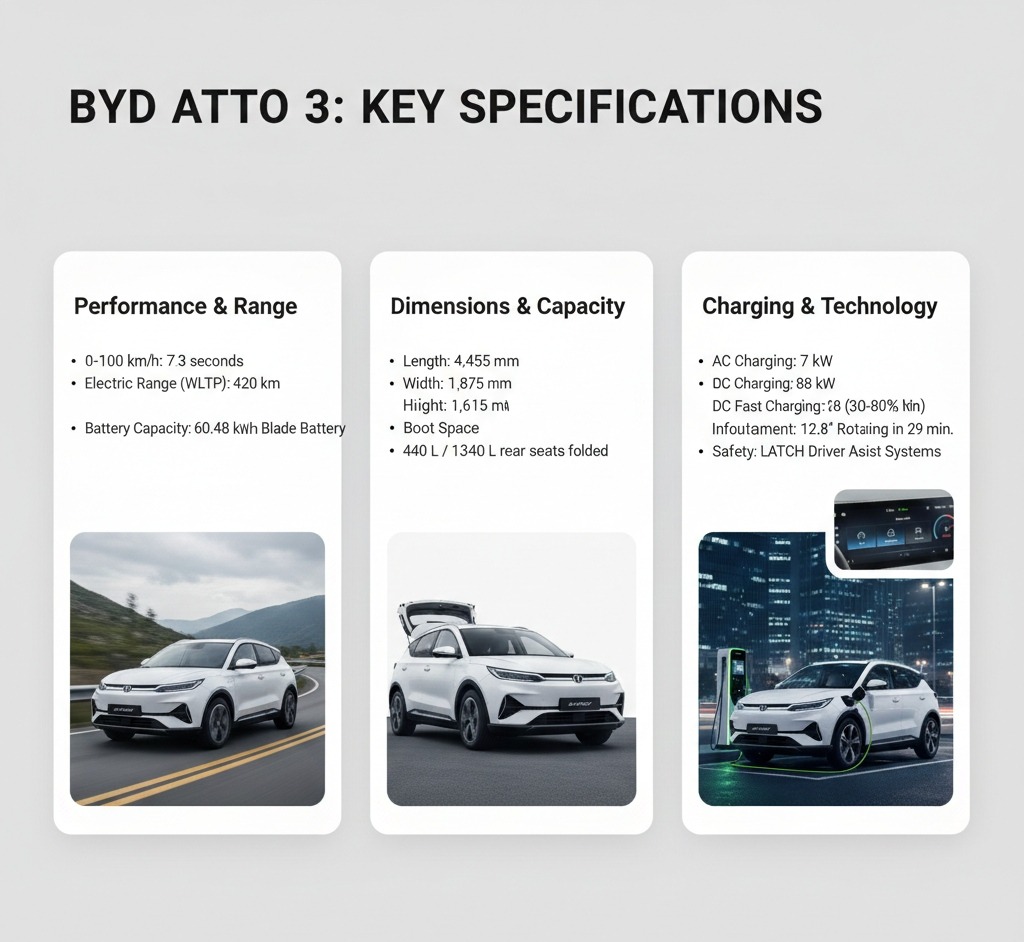
Safety is another aspect of the specs of the BYD Atto 3, with advanced driving assistance systems. It features the advanced technology of adaptive cruise control, lane-keeping assistant, and automatic braking in some serious conditions. This makes the Atto 3 the safest option in the top electric SUVs segment.
BYD Atto 3 Interior
The interior of the BYD Atto 3 is quite different from those of the upcoming electric SUVs, with a simple and unique cabin design, which can be seen in most SUVs. The most unique element used in the Atto 3 is fitness focused theme. This simple theme gives the cabin a playful environment while focusing on the build quality.

The dashboard of the Atto 3 contains a rotating display screenof 12.8 inches or 15.5 inches at the center, and it can be rotated to a portrait design or a landscape design depending on the user’s demand. This ability makes the Atto 3 feel more tech-friendly than any other competitor.
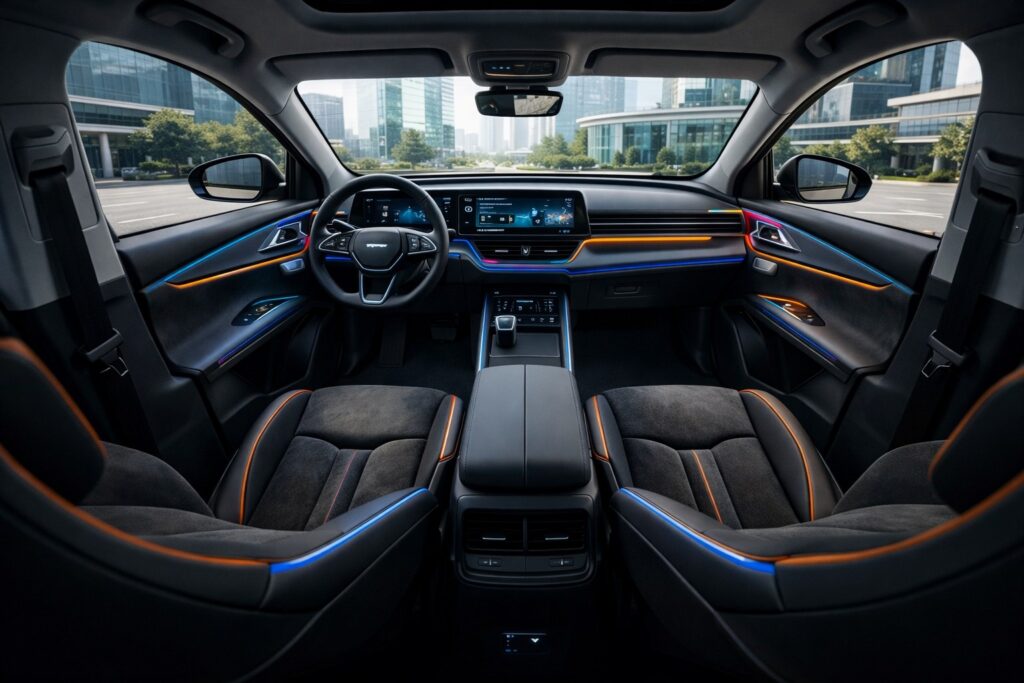
When discussing the interior materials, high-quality, premium materials are used. At some surfaces, like contact points, stitching, and trim finishes, the soft material is used, which feels premium and luxurious at an affordable price.
BYD Atto 3 Technology
The BYD Atto 3 shows the latest technology with the combination of advanced battery technology, an intelligent system, and user-friendly digital features. BYD’s e-platform 3.0 is the key technology of the Atto 3 in making it one of the most advanced electric vehicles among competitors.
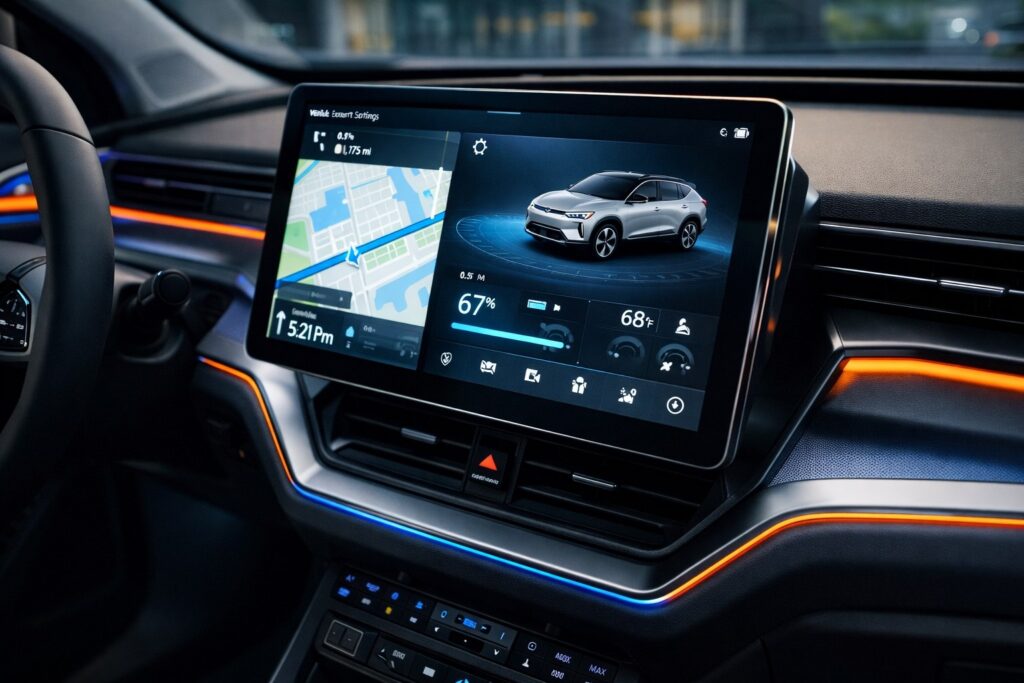
The Atto 3 uses the modern operating system, DiLink, supporting regular software updates and keeping the vehicle refreshed. This update keeps the vehicle’s performance improving continuously, keeps updating the infotainment systems, and keeps the system stable. It is updated automatically without going to any service stations.
The BYD Atto 3 also supports the vehicle-to-lead (V2L) ability, through which external devices can be powered, like laptops, camping equipment, or small appliances. These are all the features highlighting BYD’s focus on daily life routines, making it not just a transportation source but also is the mobile energy source.
BYD Atto 3 Range
The BYD Atto 3 offers a supportive range, making it suitable for both daily driving and when going on the long trips. The range relies on the type of battery used; the Atto 3 supports the blade battery, which has a capacity of around 60 kWh. This battery setup, it gives almost the WLTP range of 410 km at full charge, suitable for families going to long-distance areas.
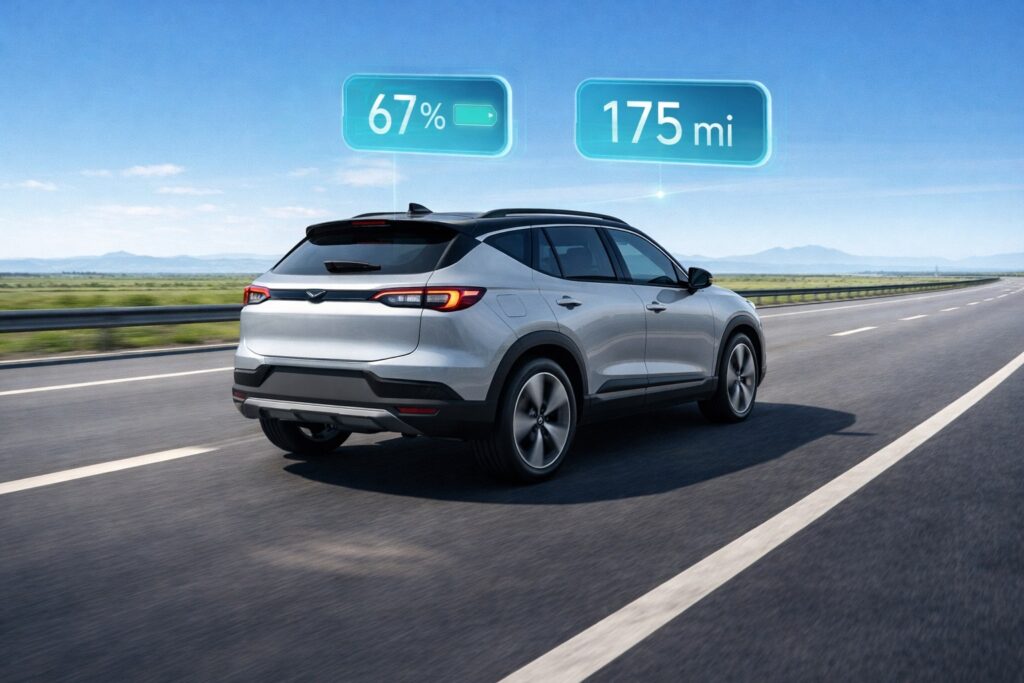
When discovering the real-world range, it is reportedly seen that the Atto gives approximately the range of 360 to 390 km at full charge, which depends on the driving style, condition, and traffic. The range is further increased in the city driving with the help of a regenerative braking system.
The other factor affecting the increase in the range of BYD Atto 3 is its heat pump system, which is only available in the newer versions. This system helps in maintaining efficiency in cold weather by consuming less battery power in heating the cabin. This results in increasing the range in cold weather compared to EVs, which do not contain this feature.
BYD Atto 3 Performance
The BYD Atto 3 gives a compatible performance, which focuses on smooth acceleration and stable handling rather than any aggressive sportiness. It has a single motor mounted on the front axle, giving an exceptional driving experience, which produces almost 150 kWh (204 hp), providing instant torque.

The Atto accelerates from 0 to 100 km/h in almost 7.3 seconds, because it is not designed as a sports vehicle, feeling effortless when overtaking any slow vehicle. On the smooth surfaces, it feels silent and has no vibration, making it more relaxed.
The throttle response of the Atto 3 is well-managed, unlike other vehicles whih feels jurk at once, helping in maintaining the comfort. A regenerative braking system also helps any vehicle to maintain performance by recovering energy regularly and maintaining the real-world range.

On the motorways, the BYD Atto 3 performs well, giving comfort and stability. With a low-mounted blade battery of Atto 3, which lowers the center of gravity, improving the road grip of the vehicle on the road, and reduces rolling down in any condition. Although it is not designed as a performance SUV, it delivers stable handling with the help of predictable steering and tuned suspension.

Driving Modes
The BYD Atto 3 contains various driving modes, like Eco, Sporty, Normal, and Snow, allowing drivers to drive in different road conditions.
- Eco mode helps in maximizing efficiency and helps in optimizing the range.
- Normal mode helps in maintaining the balance and efficiency for a smooth and comfortable driving experience.
- Sports mode helps in sharpening the throttle response, which leads to delivering quicker and more dynamic driving.
- Snow mode helps enhance the traction and power distribution for safer driving on slippery and low-gripped surfaces.
These modes make the Atto 3 suitable for any city driving or in any rough conditions, and on long journeys.

BYD Atto 3 Charging Tips
The BYD Atto 3 charging is another thing to make it popular among the top electric SUVs. The thing that gives confidence and long-term performance is that in which way the vehicle is charged. There are many options to charge the Atto 3, which can be charged at home or at public charging stations.
The climate also has a strong impact on the charging efficiency. In colder or hot weather, conditioning the cabin when the car is plugged in also helps in reducing the battery drain as the car begins. In the new BYD Atto 3, there is a heat pump system, which is efficient in helping to increase the range while heating or cooling the cabin.
BYD Atto 3 Home Charging
Charging at home is the most convenient and economical way for your Atto 3, especially when using it for your daily routine. The AC charging method is used at home for charging your vehicle, which is up to 7 Kwh. The BYD Atto 3 AC home charger takes almost 10 hours to charge from 0 to 100, which is ideal for overnight charging at home.
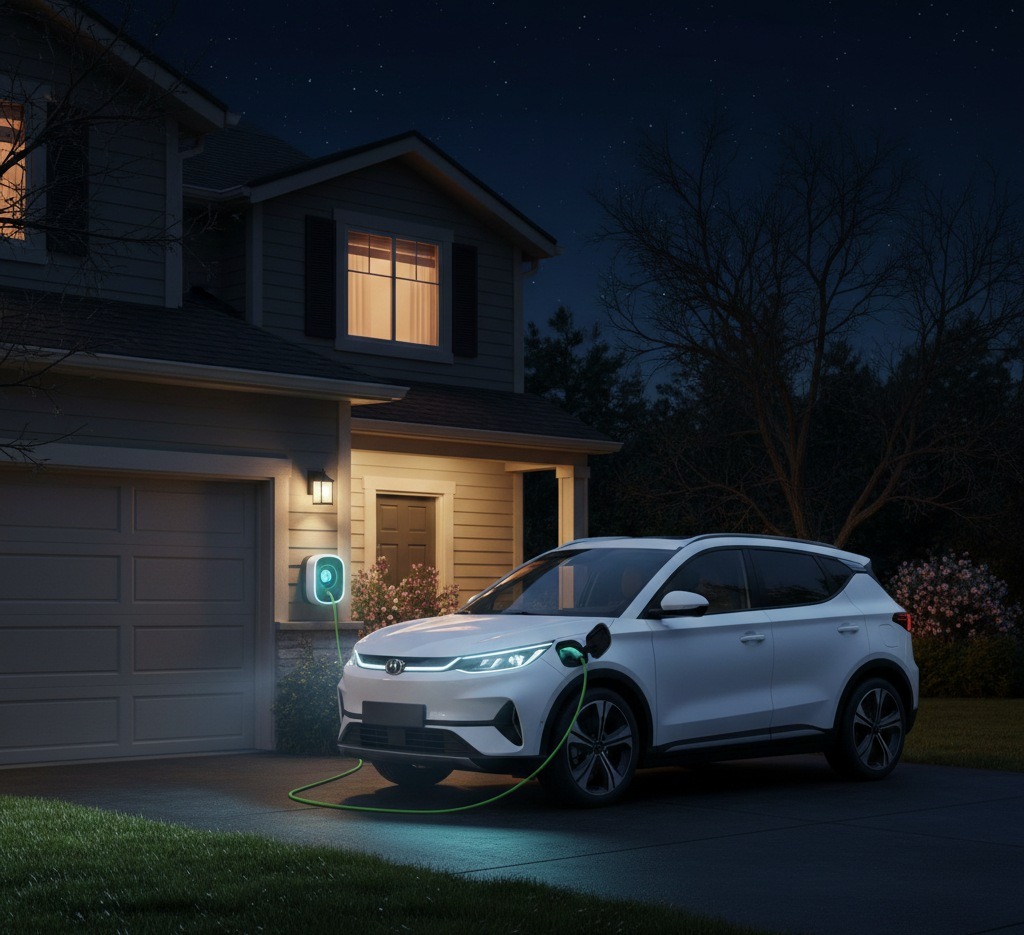
When charging at home, it does not matter whether you use a dedicated wallbox; you can directly charge your Atto 3 by using a household socket. The socket can take up to 24 hours to charge, which is probably slow and should be used in any emergency conditions. So, a proper home charging setup is required to charge the Atto 3, which gives convenience.
BYD Atto 3 Public Charging
The BYD Atto 3 is well-suited for public charging stations, which makes it a practical SUV for long-distance areas and for busy use. The public charging stations support the DC fast charging at around 88 kW, leading drivers to charge their vehicles quickly without frequent stops. When all needs are completed, it takes up to 30 to 35 minutes to fully charge your Atto 3.

Some public charging stations are also supported with the AC charging method, which are found outside the hotels, shopping centers, and offices. It has a speed of approximately 7 to 11 kW, which is slower than the DC charging method, making it suitable for any drive condition along the city side or a wide area.
BYD Atto 3 Battery
The BYD Atto 3 contains an advanced blade battery setup of lithium-ion-phosphate, which is made for durability and long-term use. It has a usable battery capacity of 60.5 kWh in the market, designed to deliver a long range.
The thing that sets the BYD Atto 3 battery apart is its cell pack of blade design, with direct thin cells. This battery structure helps in improving the vehicle’s performance and efficiency, reducing the risk of thermal runaway. The testing and the industry-based data of the battery help you to keep updated, and with nail penetration, not found in most electric SUVs.

From the perspective of the long-term, the Atto 3 offers a battery with more advantages. Unlike other vehicles that contain a nickel battery, it has a phosphate battery, which is more durable and performs well in any condition, making it an ideal option. It does not require frequent charging, which makes the ownership simpler.
The thermal management system of the battery of BYD Atto 3 helps in maintaining the temperature and keeping the battery’s health safe. In new variants, an important feature is introduced: the heat pump, which helps in enhancing the battery efficiency and keeping it safe in any weather conditions.
Is BYD Atto 3 worth buying?
The BYD Atto 3 is an excellent compact SUV for families, with its modern features, like spacious interior, comfort, modern technology, suitable performance, and elegant blade battery. So it is a great choice for city driving as well as for long distances.
What is the range of Atto 3 in KM?
The range of the Atto 3 in km varies with the battery type used in it, like almost 400+ km range for a smaller battery of 49.9 kWh, and around 500+ km range for the bigger battery of 64.7 kWh. The real-world range varies with the driving style or depending on conditions.
Is the BYD Atto 3 fully electric?
Yes, the BYD Atto 3 is a fully electric compact SUV, which is equipped with BYD’s e-platform 3.0, stating its all-electriness.
Is BYD as good as Tesla?
Now, BYD has a more comfortable ride, a more spacious interior, physical controls, and unique styling. While Tesla is better in performance, energy efficiency, charging infrastructure, and modern technology.
Conclusion
The BYD Atto 3 is now becoming an emerging electric SUV, which has become a top choice among SUVs. The reason behind its success is its performance, unique interior, and real-world range. The Atto 3 is backed by the modern blade battery technology and e-platform 3.0, which gives safety, consistent range, and long-term availability, making it a top electric SUV.
Overall, the BYD Atto 3 stands as a well-balanced electric SUV with no compromise on features or usability. For the drivers who are looking for an SUV with lower maintenance costs, safe, efficient, and advanced technology, as well as strong backlinks, the Atto 3 represents a competitive and confident step in electric vehicles.

Tesla launched the Cybertruck with promises of a revolutionary vehicle that would redefine the pickup truck segment forever. Millions of buyers placed deposits, and social media buzzed with excitement. However, the Cybertruck problems that have surfaced since delivery began tell a very different story from the polished marketing material Tesla presented to the world.
Real-world ownership is rarely as glamorous as a product launch event, and the Cybertruck has proven this point more dramatically than almost any vehicle in recent memory. Owners who had waited years for their deliveries began sharing complaints on forums, in Reddit threads, and on social media within weeks of taking possession.
This article examines the most reported Cybertruck problems, draws on verified owner complaints from across the internet, and delivers an honest, data-driven verdict on whether this electric truck is worth its considerable price tag.
The Cybertruck Hype vs. The Hard Reality
Tesla built the Cybertruck’s entire brand identity around the idea of a vehicle so durable and so advanced that traditional automotive rules simply would not apply. The stainless steel body, the sci-fi angular design, and the bold performance claims all fed a narrative of superiority that Tesla’s marketing team promoted relentlessly across social media and live events worldwide.

Consumer trust in the Cybertruck has eroded steadily as recall notices and forum complaints have accumulated into an undeniable record of systemic quality failures. Independent reviewers who tested early production trucks identified problems that should have been caught during quality control before the vehicles ever reached buyers.
The broader EV market is watching the Cybertruck’s reliability narrative closely because it shapes public perception of electric trucks as a category. Every viral post showing a rusted stainless-steel panel or a lopsided air suspension reinforces hesitation among mainstream truck buyers who are still evaluating their first EV purchase.
Most Reported Cybertruck Problems in 2026
The volume and variety of Cybertruck complaints that have emerged since mass deliveries began are staggering for a vehicle from one of the world’s most valuable automakers. Owners report issues spanning every category.
Tesla’s service center network, already stretched thin before the Cybertruck launched, has struggled to keep pace with the wave of warranty claims flooding in from owners nationwide. Service appointments frequently stretch weeks into the future, leaving owners driving defective vehicles or going without their trucks entirely during repairs.

Body Panel Gaps and Exterior Fit Issues
The Cybertruck’s angular stainless steel exterior panels are unlike anything else on the market, and its unconventional design has created a unique set of quality control nightmares that persist in new models.
Most of the owners consistently report visibly uneven panel gaps, with some measuring discrepancies of 10 mm or more between adjacent panels on brand-new deliveries. In contrast, mainstream trucks like the Ford F-150 Lightning typically achieve panel gap tolerances under 4mm as a basic quality standard.
Stainless Steel Rusting and Surface Staining
One of the most ironic Cybertruck problems involves the material Tesla specifically chose for its supposed durability; the stainless steel body is rusting and staining at an alarming rate. Orange rust spots began appearing on Cybertrucks within weeks of delivery in certain climates, particularly in coastal areas and states that use road salt during winter months.
Surface staining from brake dust, road tar, and industrial fallout proves extremely difficult to remove from the textured stainless steel surface without specialist products. Unlike traditional painted vehicles, where contamination sits on a clear coat layer, the Cybertruck’s brushed metal finish allows contaminants to bond directly with the steel surface at a microscopic level.
Windshield Wiper One Blade, Endless Complaints
The Cybertruck’s single giant windshield wiper is one of the most polarizing design decisions in automotive history, and owner complaints in 2026 confirm it is also one of the most problematic. The single massive blade must cover an enormous trapezoidal windshield surface that is significantly larger than any standard passenger vehicle, creating streaking.
Replacement wiper blades for the Cybertruck are not standard automotive parts and must be sourced specifically through Tesla or authorized suppliers, often at prices several times higher than conventional truck wiper replacements. Motor failures require service center visits, given Tesla’s scheduling backlog.
Air Suspension Failures and Uneven Ride
The Cybertruck’s adaptive air suspension system was marketed as a sophisticated feature allowing the truck to adjust ride height for different terrain types, but owners have discovered it is one of the vehicle’s most failure-prone components. Air suspension compressor failures, airline leaks, and electronic control module malfunctions have left trucks sitting lopsided in driveways and parking lots across the country.
The software controlling the air suspension has also been the subject of multiple over-the-air updates attempting to address erratic behavior, including unexpected ride height changes during highway driving and failure to maintain set positions on unlevel ground.
Cybertruck Interior Problems Owners Hate
Beyond the headline-grabbing exterior defects, Cybertruck interior problems have generated their own substantial wave of owner frustration across complaint threads and forums. The cabin design prioritizes minimalism to an extreme degree, stripping away physical controls and routing virtually every function through a single large touchscreen.
Material quality inside the cabin has also drawn disproportionate criticism for the vehicle’s premium price point. Trim pieces have separated from their surfaces, stitching on the seating has come undone within months of delivery, and rattles from ill-fitting interior panels create a constant reminder of the build-quality issues that plague the entire vehicle.

Yoke Steering Wheel Usability in Daily Driving
Tesla’s decision to equip the Cybertruck with a yoke-style steering wheel instead of a traditional wheel remains one of the most controversial choices the company has made, and daily drivers are paying the price in usability.
The yoke’s lack of a complete wheel rim means that drivers must consciously reposition their hands during turns rather than allowing the wheel to slide through their fingers naturally. Emergency steering corrections become more mentally demanding since the intuitive grab-and-turn motion that round wheel users have trained for decades does not apply.
Touchscreen Lag and Software Glitches
The Cybertruck’s entire control system depends on an 18.5-inch center touchscreen, making any software malfunction or lag event a vehicle-wide problem rather than a minor inconvenience.
Software glitches extend beyond the main touchscreen to the instrument cluster, the rear display, and the various driver assistance systems that depend on the vehicle’s central computing platform. Phantom braking events, autopilot disengagements in clear conditions, and incorrect range calculations have all been reported with concerning frequency across owners.
Cybertruck Range Problems: Real-World vs. EPA Numbers
The EPA-rated range figures that Tesla advertises for the Cybertruck look impressive on a specification sheet, but Cybertruck range problems in real-world conditions represent one of the most consistent disappointments that owners experience from their very first drive.
Cold-weather driving creates particularly dramatic range reductions that catch many first-time EV truck buyers completely unprepared. Owners in northern states and Canadian provinces report available range dropping by 35 to 45 percent on cold winter mornings when the battery requires significant energy just to heat itself to optimal operating temperature.
Cybertruck Recall History: How Many Times and Why
The Cybertruck recall history stands as perhaps the most damaging aspect of the vehicle’s short production life, with a frequency of safety-related recalls that is genuinely unprecedented for a modern full-size truck.
The cumulative effect of these recalls on resale values has been severe, with used Cybertruck market values declining sharply as each new announcement reinforces the narrative of poor quality control.
Build Quality Complaints Straight from Owner Forums
The most unfiltered source of Cybertruck build quality complaints comes from the vehicle’s own dedicated owner communities on Reddit, Facebook groups, and specialty forums where members post detailed documentation of every defect they encounter.

Common complaints documented across these communities include misaligned frunk lids that do not seal properly, charge port doors that stick or fail to open on command, interior trim panels that rattle over rough pavement, and exterior stainless steel panels with visible machining marks and surface irregularities noticed immediately upon delivery.
Is the Cybertruck Reliable for Work and Towing?
The fundamental promise of any pickup truck is its ability to perform real work, and Cybertruck reliability complaints in work contexts represent a critical failing for a vehicle positioned directly against proven trucks from Ford, Ram, and Chevrolet.
Most importantly, the consequences of an unreliable work truck are not merely inconvenient; a truck that breaks down on a job site or fails to tow a load costs its owner real money and professional reputation.
Towing in Cold Weather: A Known Weak Spot
Cybertruck towing problems in cold weather have emerged as one of the most serious reliability concerns for owners in northern climates, where the truck’s electric powertrain physics work directly against its stated towing capability.
Tesla’s maximum tow rating sounds impressive in specifications, but real-world towing tests by independent reviewers have documented range reductions of 50 to 70 percent when towing at or near rated capacity in cold conditions.
Payload Capacity Complaints from Contractors
Contractor and tradesperson owners have raised pointed concerns about the Cybertruck’s real-world payload capacity, noting that the rated payload figures require very specific configurations that most working truck buyers would not choose.
The truck’s composite bed liner creates a loading height that some tradespeople find impractical for heavy material deliveries without additional equipment. Tie-down points in the bed have also drawn complaints for their placement and load ratings, with several contractors documenting load shifting during transport.
What Tesla Has Fixed, and What Is Still Broken
Honesty requires acknowledging that Tesla has addressed some Cybertruck problems through over-the-air software updates and service-based remediation programs, and not every issue that plagued early deliveries remains unresolved in vehicles.
However, the physical quality control issues that stem from manufacturing process limitations are considerably harder to fix via software and remain stubbornly persistent in 2026 vehicles. Panel gaps, stainless steel surface quality, interior rattles, and air suspension reliability have not shown the same trajectory of improvement that software issues have demonstrated.
Cybertruck Problems vs. Competitors: F-150 Lightning and Ram 1500 REV
Comparing Cybertruck problems with those of its direct electric truck competitors provides essential context for buyers evaluating the segment as a whole, and the comparison does not flatter Tesla’s product in most categories that work-truck buyers prioritize.
The Ram 1500 REV, while newer to the market, has emerged with notably fewer reported quality control complaints per vehicle delivered than the Cybertruck has generated during its production run.

| Metric | Cybertruck | F-150 Lightning | Ram 1500 REV |
| Real-World Range vs. EPA | 15–25% below | 10–15% below | 12–18% below |
| Build Quality Complaints | Very High | Moderate | Low–Moderate |
| Service Wait Times | 3–6 weeks avg. | 1–2 weeks avg | 1–3 weeks avg |
| Cold Weather Towing | Significant limitation | Moderate limitation | Moderate limitation |
| Software Reliability | Inconsistent | Stable | Stable |
| Recall Frequency | Very High | Moderate | Low |
Should You Still Buy a Cybertruck in 2026?
The question of whether a Cybertruck is worth buying in 2026 requires an honest assessment of who the buyer is and what they specifically need from a vehicle, because the answer genuinely varies depending on those factors.
For buyers who prioritize technology, unique design, and the Tesla ecosystem above all other considerations, the Cybertruck remains a compelling if imperfect choice that delivers on its futuristic promise better than any alternative in the market.
However, buyers who need a reliable daily work truck, plan to tow regularly in cold climates, or require fast service access when problems arise will find the Cybertruck a frustrating and potentially expensive ownership experience.
What issues does the Cybertruck have?
Cybertruck issues commonly reported by owners include panel alignment problems, software glitches, windshield cracking, rust-like surface stains on the stainless-steel body, range reduction while towing, charging challenges in some locations, and occasional recalls related to safety and hardware components.
Why is the Cybertruck not selling well?
The Tesla Cybertruck is not selling as strongly as expected due to its high price, polarizing design, production challenges, quality concerns, recalls, and increasing competition from electric and traditional pickup trucks. Limited practicality for some buyers and lower-than-expected demand have also contributed to slower sales growth.
Why does no one like the Cybertruck?
Not everyone dislikes the Cybertruck, but it has sparked strong opinions. Common criticisms include its unconventional angular design, large size, high price, build-quality concerns, recalls, and questions about practicality compared to traditional pickup trucks.
Conclusion
Cybertruck problems in 2026 are real, documented, persistent, and in some cases serious enough to affect vehicle safety, and any buyer or current owner deserves to hear that assessment plainly rather than filtered through brand enthusiasm.
For buyers who have already made their purchase, the best path forward involves staying current with all recall remediation work, establishing a relationship with a responsive Tesla service advisor, and using the owner community forums to track emerging issues before they become critical failures.

Electric SUVs have rapidly become one of the most important segments in the automotive industry. As fuel prices fluctuate and governments push toward electrification, more drivers are switching to EVs for efficiency and lower running costs.
Among these vehicles, the Tesla Model Y has emerged as one of the most popular choices worldwide. Buyers are attracted to its long driving range, impressive performance, and highly advanced technology.
This article explores the Tesla Model Y pros and cons (2026) using expert testing data and real owner experiences. Whether you are considering your first electric vehicle or upgrading from another EV, understanding its strengths and weaknesses is essential.
We will analyze real-world performance, charging capabilities, ownership costs, and daily usability. By the end, you will know whether the Model Y is the right electric SUV for your lifestyle.
What Makes the Model Y Stand Out?
The Model Y immediately stands out with its minimalist design and aerodynamic profile. Unlike traditional SUVs with aggressive styling, Tesla’s approach emphasizes simplicity and efficiency. So that it stands out as a top electric SUV in the segment.
Inside the cabin, the design philosophy continues. Instead of physical buttons, nearly all vehicle controls are integrated into a large central touchscreen. This creates a clean interior layout that feels closer to a modern tech product than a conventional car.
Another defining feature is the continuous improvement model. Tesla vehicles receive frequent over-the-air software updates, which can introduce new features, improve performance, and enhance efficiency over time. For many owners, this evolving software ecosystem makes the car feel like it improves long after purchase.
Performance and Driving Experience
One of the best things about the Model Y is how well it performs. The electric motors give it instant torque, which lets it speed up quickly and deliver power smoothly. With this excellent performance and power delivery, it beats many of the electric SUVs.

Drivers often notice the difference immediately when switching from gasoline vehicles. The absence of engine noise combined with rapid acceleration creates a refined and responsive driving experience.
Moreover, the vehicle maintains strong stability at highway speeds. Tesla’s low battery placement lowers the center of gravity, which improves handling compared with many traditional SUVs.
Acceleration and Speed
The long-range all-wheel-drive version accelerates from 0 to 60 mph in about 4.3 seconds. That is incredibly quick for a compact family SUV. Instant electric torque eliminates traditional gear shifts. As a result, acceleration feels smooth and immediate. Many drivers describe it as addictive after experiencing it for the first time.
In real-world driving situations, this performance improves safety as well. Fast acceleration allows confident highway merging and easier overtaking of slower traffic. This smooth delivery states the work of manufacturers on the vehicle.
One-Pedal Driving Feel
Regenerative braking is one of the most important features of Tesla cars. The car slows down and saves energy on its own when the driver takes their foot off the gas. This lets you drive with just one pedal, which means you can change speeds without using the brake pedal. Many drivers find the system easy to use after a short learning curve.

City driving becomes more comfortable as the vehicle decelerates naturally when approaching traffic lights or slower vehicles. Furthermore, recovered energy slightly increases overall driving efficiency.
Range, Charging and Daily Usability
Driving range remains one of the most important considerations when selecting an electric SUV. Fortunately, the Model Y performs well in this category. The long-range version has an EPA rating of approximately 321 to 327 miles, depending on configuration. This distance allows for several days of commuting without recharging.

For most drivers, daily charging happens at home overnight. As a result, the vehicle starts each morning with a full battery, eliminating frequent fuel station visits. This removes your concern, and you can continue your day with no worry.
Real-World Range vs Claims
Real-world testing has shown that the Model Y often matches its official range rating. Independent highway tests have recorded approximately 327 miles of driving distance, confirming Tesla’s efficiency claims.
Energy consumption averages about 26.8 kWh per 100 miles, which places the Model Y among the most efficient electric SUVs currently available. However, environmental factors still matter. Cold weather can reduce range by up to 20 to 30 percent. Drivers typically compensate by preconditioning the battery before driving.

Supercharger Network Advantage
Tesla’s charging ecosystem remains a major competitive advantage. The Tesla Supercharger network includes thousands of fast-charging locations worldwide. The Model Y supports charging speeds up to 250 kW. Under ideal conditions, drivers can add about 100 miles of range in 15 minutes.
Even more importantly, the navigation system automatically integrates charging stops during long road trips. Drivers simply enter a destination, and the system calculates optimal charging locations. If you are new EV owners, this convenience significantly reduces your range anxiety.

Interior, Space and Practicality
Despite its compact classification, the Model Y offers impressive interior space. The flat floor created by the battery pack increases passenger legroom in both rows. The spacious and simple layout of the cabin also influences the most.

Cargo capacity is another highlight. With the rear seats folded, the vehicle offers up to 76 cubic feet of storage space. This makes it one of the most practical vehicles in its category, making it best for family use and for longer trips without any fatigue.
Tesla also includes additional storage areas:
- Front trunk (frunk)
- Hidden cargo compartments
- Deep center console storage
Families often appreciate the versatility during road trips or grocery runs.
Technology and Smart Features
Technology is arguably Tesla’s most significant competitive advantage. The Model Y feels more like a connected smart device than a traditional automobile. The centerpiece is the large central touchscreen that manages navigation, climate controls, entertainment, and vehicle settings.
Tesla also pushes regular software updates that add features and improve performance. Few other automakers currently match this level of continuous vehicle improvement. This approach is the main reason for the success of the vehicle among a world full of EVs.
Autopilot and Driver Assistance
Tesla Autopilot comes as standard on the Model Y. Autopilot can maintain lane position and adjust speed in response to traffic conditions. This greatly reduces fatigue on long highway drives.
Tesla also offers an optional upgrade called Full Self-Driving. Although it still requires driver supervision, it introduces advanced navigation assistance and automated lane changes. For many owners, this technology transforms long-distance driving into a far more relaxed experience.
Infotainment and App Control
Tesla owners control many vehicle functions through the Tesla app. The app enables remote climate control, charging monitoring, location tracking, and vehicle locking. Drivers can also use their smartphone as the primary car key.
The infotainment system includes built-in streaming apps, navigation, and gaming features. While unconventional, the integrated ecosystem provides a unique ownership experience. And feel more joy and make your journeys enjoyable as well as courageous.
Running Costs and Long-Term Value
Electric vehicles are typically less expensive to operate than gasoline cars. Model Y is no exception. In most areas, electricity is significantly cheaper than fuel. Owners often save money on daily commuting costs as a result.

Maintenance costs are also lower because EVs have fewer mechanical components. There are no oil changes, spark plugs, or complex transmissions to service. Tesla provides an 8-year battery warranty, which increases long-term ownership confidence.
Tesla Model Y Cons (Where It Falls Short)
Despite its strengths, the Model Y is not without drawbacks. Both reviewers and owners frequently mention some weaknesses. Most critics highlight issues with ride comfort, interior refinement, and usability challenges stemming from the touchscreen interface.
However, these trade-offs are often subjective. Many drivers accept them in exchange for strong performance and technology features. Despite the numerous advantages, one should not overlook the fewer drawbacks.
Build Quality and Reliability Concerns
Tesla’s build quality has improved over the years, but some inconsistencies remain. Some owners report minor paint imperfections or uneven panel gaps. Service visits frequently resolve these cosmetic issues. Nevertheless, competing manufacturers occasionally provide more consistent initial build quality.

Ride Comfort and Suspension Issues
Earlier versions of the Model Y were chastised for their stiff suspension. The new version includes improvements to reduce harshness. Despite these changes, some drivers report a slightly firm ride on rough roads. Competitors like the Hyundai Ioniq 5 offer a softer suspension feel. However, the firmer setup helps to improve handling and stability at higher speeds.

Touchscreen Dependency and Usability Problems
Tesla’s simple design gets rid of most physical buttons. Most changes are made through the main screen. This interface makes sense to drivers who know a lot about technology. Some people, on the other hand, think it is distracting while driving. Simple tasks such as adjusting mirrors or climate controls require multiple touchscreen inputs.
Missing Features (No CarPlay, Limited Options)
Unlike many vehicles, Tesla does not support Apple CarPlay or Android Auto. Instead, Tesla relies on its own software ecosystem. Although powerful, it limits smartphone integration options. Some buyers prefer traditional connectivity features offered by other automakers.
Real-World Drawbacks (Range Drop, Visibility, Small Issues)
Several minor usability issues arise during long-term ownership. For example, the rear window is relatively small, limiting rear visibility. When driving in reverse, drivers rely heavily on camera systems. Furthermore, cold temperatures can reduce battery life. Fortunately, Tesla’s battery preconditioning reduces this effect.
Competition: How Does It Compare to Other EVs?
The Model Y competes in a rapidly expanding electric SUV market. Major competitors include the Ford Mustang Mach‑E, the Hyundai Ioniq 5, and luxury options like the BMW iX. They compete with the Model Y in every aspect, from interior to performance.

| Model | Range | Charging speed | Strength |
| Model Y | Approximately 320+ miles on a single charge. | 250 kW | Charging network |
| Ioniq 5 | Approximately 300+ miles on a full battery. | 350 kW | Ultra-fast charging |
| Mach-E | Approximately 310+ miles. | 150 kW | Sporty handling |
Overall, Tesla still leads in charging infrastructure and software integration.
What is the weakness of the Tesla Model Y?
The main weaknesses of the Tesla Model Y are:
- The steering feels heavy and feels like it looses power.
- The Model Y’s suspension is a common problem. It feels like it wears out too quickly, makes noise over bumps, and wears out tires unevenly.
- Another issue is braking, which feels heavier at an instant and loses grip.
- There is a need to improve the electronics, which means that the random error message comes anytime, there are infotainment bugs, and the door glitches.
What are the downsides of having a Tesla?
Having a Tesla is not a big deal for you, but the insurance and the maintenance costs are the downsides of having a Tesla. As there is no need of oil changes, but if the door stops working or the touchscreen gets faulty. Then your +$1000 can be required for the repair.
Is the Tesla Model Y any good?
The Tesla Model Y is a great choice for daily driving, with smooth acceleration and impressive performance. The Long Range All-Wheel Drive model accelerates from 0 to 60 mph in 4.2 seconds, outpacing competitors such as the Hyundai Ioniq 5.
Why are people getting rid of Teslas?
Drivers are switching to other electric vehicles because Tesla insurance rates are going up. A survey found that Elon Musk was one of the main reasons drivers were getting rid of their Teslas in 2023, but most of those drivers still chose to stay electric.
Conclusion
The Tesla Model Y is still one of the most complete electric SUVs available in 2026. It combines powerful performance, a long driving range, and a technology-focused experience that few competitors can match.
For a lot of buyers, the best things about it are its efficient electric powertrain, its connection to the Tesla Supercharger network, and the fact that it gets software updates all the time. These features make it easier to own a car every day, whether you drive to work every day or go on longer road trips.
Overall, the Model Y works best for drivers who value technology, efficiency, and performance over traditional luxury features. It offers excellent practicality, low running costs, and a modern ownership experience that continues to improve through software updates.

Electric SUVs have moved from early-adopter territory into the mainstream. Buyers now expect them to do everything a traditional family SUV can do, including daily commuting, weekend travel, school runs, motorway driving, and long-distance comfort. That is why range, charging speed, and real-world efficiency matter more than ever.
For anyone considering BMW’s electric SUV lineup, the BMW iX3 range and charging time are usually the first things to check. Most buyers want to know one simple truth: can this vehicle handle real life without becoming inconvenient? That question becomes even more important for drivers moving from petrol or diesel into their first EV.
This guide breaks everything down in practical terms. We will look at claimed range, real-world performance, charging times at home and on the road, running costs, and how the iX3 compares with key rivals like the Tesla Model Y and Audi Q4 e-tron. By the end, you should have a much clearer idea of whether the BMW iX3 is the right electric SUV for your needs.
BMW iX3 Range Overview
When looking at any electric SUV, the first thing buyers look at is the range. BMW markets the iX3 as a useful daily electric vehicle, but it’s important to know how its range works in real-world situations.
Official figures provide a baseline, but real-world usability depends on multiple variables. Therefore, comparing claimed range with actual driving experience gives a clearer picture of what to expect.
Official WLTP Range
The BMW iX3 offers an official WLTP range of approximately 450+ km in earlier versions. Newer-generation models are expected to deliver up to 400 miles under ideal conditions, thanks to improved battery technology.

Controlled testing environments achieve these figures. Specifically, WLTP testing assumes moderate speeds, stable weather, and minimal energy loss from external factors. As a result, these numbers represent best-case scenarios rather than everyday driving.
For you, when finding the best SUV, the result means the official range should be treated as a benchmark, not a guaranteed outcome. It helps compare vehicles, but it does not fully reflect real-world performance
Real-World Driving Range
In real-world conditions, the BMW iX3 typically delivers between 380 and 420 km on a full charge. This range varies depending on your driving style, road conditions, and external temperatures.
For example, city driving with frequent braking can actually improve efficiency due to regenerative braking. On the other hand, highway driving at higher speeds is likely to reduce range more quickly.
Compared to competitors, the iX3 performs efficiently. Many drivers report around 2.7 miles per kWh, which is better than heavier rivals like the Audi e-tron or Mercedes EQC. Therefore, while it may not have the highest claimed range, it often performs consistently in daily use.
Range in Different Weather Conditions
Weather plays a critical role in EV performance. Because of cabin heating, cold weather lowers battery efficiency and increases energy consumption. As a result, winter driving can lower range by 10–20%. In contrast, moderate temperatures allow the battery to operate more efficiently. However, extremely hot climates can also impact performance due to cooling system demands.
Driving behavior further strengthens these effects. Aggressive acceleration, heavy loads, and constant high speeds can significantly reduce range regardless of weather. Therefore, maintaining smooth and consistent driving habits is key for you in maximizing efficiency.
Battery Capacity and Efficiency Explained
Battery performance is the foundation of any electric vehicle. It directly affects range, charging speed, efficiency, and long-term ownership experience. Therefore, understanding how the BMW iX3 battery works helps you figure out its real value.
Unlike traditional engines, EV batteries require careful management. Manufacturers design them with buffers and software controls to ensure durability and consistent performance over time.

Battery Size and Usable Capacity
The BMW iX3 is equipped with an 80 kWh battery pack, but not all of this capacity is usable. In real-world terms, around 74 kWh is available for driving. This battery capacity is beneficial for you when finding a mid-size electric SUV.
This difference exists to protect the battery. By limiting full charge and deep discharge, BMW ensures longer battery lifespan and stable performance. As a result, you can experience less degradation over time compared to fully exposed battery systems.
Additionally, newer iX3 models introduce improved battery architecture, including 800V systems. These upgrades not only enhance efficiency but also allow faster charging under optimal conditions. For long-term ownership, this buffer system plays a critical role in maintaining battery health.
Energy Consumption (kWh per 100 km)
The BMW iX3 consumes approximately 161 Wh per kilometer, which is considered efficient for a mid-size electric SUV. This efficiency translates into better real-world range and fewer charging stops.
To put this figure into perspective, some competitors like the Mercedes EQC consume significantly more energy due to a heavier design. Consequently, even if they offer similar battery sizes, their usable range often falls behind.
Efficiency also impacts cost. Lower energy consumption means reduced electricity usage per kilometer. Therefore, over time, the iX3 can be more economical to operate compared to less efficient EVs. Moreover, BMW integrates regenerative braking technology to improve efficiency further. This system recovers energy during deceleration, especially in urban traffic conditions.
BMW iX3 Charging Time Breakdown
Charging time is one of the biggest concerns for EV buyers. While range determines how far you can go, charging determines how practical the vehicle is in daily life and long trips. It is the most important thing for you while choosing an electric SUV.
The BMW iX3 offers multiple charging options, each suited for different use cases. From overnight home charging to rapid highway charging, understanding these options helps you plan ownership more effectively.
AC Charging Time (Home Charging)
Home charging is where the BMW iX3 truly shines in daily usability. You can plug in your vehicle overnight, ensuring a full battery every morning without visiting public stations and without wasting any extra money; you can make it worth it.

Using a standard 7 kW home charger, a full charge takes approximately 10 to 12 hours. This fits perfectly within overnight charging routines. However, upgrading to an 11 kW wall box reduces this time to around 7 to 8 hours.
In real-world ownership, this means you rarely need to think about charging. As long as you have a home setup, the iX3 behaves much like a smartphone—plug in at night and forget about it.
DC Fast Charging Time (0–80%)
For long-distance travel, rapid charging becomes essential. The BMW iX3 supports DC fast charging up to around 150 to 155 kW, allowing rapid energy regeneration. This removes your concern when hanging out on long trips with families.
In practical terms, charging from 10% to 80% takes approximately 24 to 31 minutes. Newer-generation models with improved battery systems can reduce this time to around 21 minutes under ideal conditions.

However, real-world charging speeds may differ. Factors such as charger availability, battery temperature, and station power output influence performance. Charging also slows down after 80% to protect battery health.
Charging Options for BMW iX3
Charging flexibility is one of the biggest advantages of owning an electric SUV like the BMW iX3. Unlike fuel cars, you have the freedom to charge your BMW iX3 at home, at work, or on the road. Instead, you can charge at home, at work, or on the road.
However, understanding the available charging options helps you avoid inconvenience and plan your usage efficiently. Therefore, knowing where and how you will charge is just as important as knowing how fast it charges.

The BMW iX3 supports both AC (alternating current) and DC (direct current) charging systems. For home and workplace charging, it uses a Type 2 connector, which is widely available across most regions. For rapid charging, the iX3 uses a CCS connector. Most public charging networks support this global standard for DC fast charging.
As a result, the iX3 offers strong compatibility across different charging infrastructures. In many regions, even Tesla Superchargers now support CCS-compatible vehicles, which further improves accessibility.
From a real-world perspective, most owners rely on three main charging scenarios:
- Home charging (primary method): Used for daily driving, overnight charging, and lowest cost.
- Public AC charging (secondary option): Useful in shopping centers, offices, or long parking durations.
- DC fast charging (travel use): Designed for highways and long-distance trips.
Another important feature is smart charging integration. The BMW iX3 can plan charging stops automatically using its navigation system. This means the vehicle calculates when and where to charge based on your route.
From an ownership perspective, charging convenience depends heavily on your setup. If you have access to home charging, the experience becomes seamless. Without it, reliance on public infrastructure may require more planning.
What Affects BMW iX3 Range and Charging Speed?
Even though the BMW iX3 offers solid range and charging performance, real-world results can vary significantly. This is because EV performance depends on multiple external and behavioral factors. Understanding these factors helps you get the most out of your vehicle. More importantly, it allows you to plan trips better and avoid unexpected range drops or slow charging sessions.

Driving Style and Speed
Driving style has a direct impact on energy consumption. Rapid acceleration and high-speed driving increase power demand, which reduces overall range. For example, maintaining a steady speed on highways improves efficiency compared to frequent acceleration and braking. Smooth driving can extend range noticeably, especially on long trips.
In addition, using eco-driving modes can help optimize energy usage. Therefore, drivers who adopt efficient habits often achieve better real-world performance than expected. The iX3 has different driving modes, which helps you in increasing the vehicle’s performance.
Weather and Temperature
Temperature significantly affects battery performance. Cold weather reduces battery efficiency and increases energy consumption due to heating systems. In winter, range can drop by 10–20%, depending on conditions. On the other hand, moderate temperatures allow the battery to operate at optimal efficiency.

Taking care of the vehicle while it is plugged in helps reduce energy loss. This feature warms or cools the battery before driving, improving both range and charging performance. When the weather is extremely hot, you should take care of the battery’s temperature. Because it can affect your vehicle’s performance.
Road Conditions
Road conditions also influence energy usage. Driving uphill requires more power, which reduces range faster. In contrast, flat roads and steady cruising improve efficiency. However, regenerative braking helps recover energy when slowing down or driving downhill. This is especially effective in city traffic, where frequent stops allow energy recovery.
BMW’s adaptive recuperation system further enhances this process. It automatically adjusts braking strength based on traffic conditions, improving both comfort and efficiency. Overall, these factors highlight an important point: EV performance is dynamic. While official figures provide guidance, real-world results depend on how and where you drive.
Is the BMW iX3 suitable for long-distance travel?
Long-distance travel is often the biggest concern for EV buyers. While daily commuting is easy to manage, road trips require planning around charging stops, infrastructure, and time efficiency. The BMW iX3 is designed to handle long journeys reasonably well. However, its practicality depends on how effectively you use its charging capabilities and available infrastructure.

One of the key strengths of the iX3 is its fast-charging support. With the ability to charge from 10% to 80% in around 25–30 minutes, it allows drivers to take short breaks rather than long waiting periods.
In real-world scenarios, this means you can stop every 300–350 km for a quick recharge. These stops often align with rest breaks for food or coffee, making the experience more manageable than many first-time EV buyers expect.
Another important advantage is intelligent route planning. The BMW iX3 can automatically calculate charging stops based on your destination, current battery level, and driving conditions. For example, if you are driving at higher speeds, the system may recommend an earlier charging stop. This predictive approach reduces the risk of running low on battery unexpectedly.
However, when compared to competitors like the Tesla Model Y, the charging experience is slightly less seamless. Tesla’s integrated Supercharger network still offers better coverage and ease of use in many regions.
That said, public charging networks are expanding rapidly. As a result, long-distance EV travel is becoming easier every year, and the iX3 benefits from this growing infrastructure. Compare top electric SUVs before buying to see how the iX3 stacks up for long-distance use.
From an ownership perspective, the iX3 is more than capable of handling road trips. It may require slightly more planning than traditional vehicles, but it delivers a comfortable and efficient travel experience.
BMW iX3 vs Other Electric SUVs
When you research electric SUVs, you rarely look at one model in full view. Instead, you compare options across range, charging speed, efficiency, and overall usability. This makes it easier for you to choose the best SUV according to your use.

The BMW iX3 competes directly with models like the Tesla Model Y, Audi Q4 e-tron, and even premium options like the BMW iX. Each offers different strengths, so understanding how the iX3 fits into this landscape is essential.
To simplify things, here’s a direct comparison of key performance factors:
| Model | Real-World Range | Fast Charging (10–80%) | Efficiency | Strength |
| BMW iX3 | 380 to 420 km | 24 to 31 min | High | Balanced performance |
| Tesla Model Y | 450 to 500 km | Approximate 20 min | Very High | Charging network |
| Audi Q4 e-tron | 400 to 450 km | Approximate 30 min | Moderate | Comfort and design |
| BMW iX | 500+ km | Approximate 30 min | High | Premium tech |
From a range perspective, the Tesla Model Y leads slightly. It offers longer real-world distance and better efficiency due to advanced battery management. However, the BMW iX3 remains competitive. Its consistent efficiency means it performs reliably in daily use, even if its peak range is slightly lower.
In terms of charging, Tesla again has an advantage due to its integrated Supercharger network. The experience is smoother, with less reliance on third-party apps and compatibility checks. That said, the BMW iX3 still delivers strong charging performance. Its ability to reach 80% in around 25 minutes keeps it practical for road trips, especially as public infrastructure improves.
Where the iX3 stands out is balance. It offers a mix of efficiency, driving comfort, and predictable performance without pushing extremes. For example:
- It is more efficient than heavier SUVs like the Audi e-tron.
- It is more affordable than premium models like the BMW iX
- It offers a traditional BMW driving feel, which many drivers prefer.
From my perspective, the choice depends on priorities:
- Choose the Tesla Model Y if charging convenience is your top priority.
- Choose the BMW iX3 if you want balanced performance and familiar driving dynamics.
- Choose the Audi Q4 e-tron if comfort and interior design matter most.
Pros and Cons of BMW iX3 Range and Charging Time
When evaluating any electric SUV, it’s important to look beyond specifications. Real ownership experience depends on how well the vehicle balances range, charging convenience, and everyday usability.

The BMW iX3 performs strongly in many areas. However, like any EV, it also comes with certain limitations that buyers should consider carefully.
Key Advantages
There are some vital advantages of the iX3:
- One of the biggest strengths of the BMW iX3 is its real-world efficiency. Even though it does not lead in peak range numbers, it consistently delivers reliable performance in daily driving.
- Another major advantage is predictable charging behavior. The vehicle supports fast charging up to 150 kW, allowing practical long-distance travel without excessive waiting times.
- Additionally, the iX3 benefits from BMW’s refined driving dynamics. It feels familiar to traditional SUV drivers, making the transition from petrol vehicles much easier.
Other key advantages include the following:
- Lower running costs compared to fuel vehicles
- Strong regenerative braking system for energy recovery
- Wide compatibility with public charging networks
Limitations to Consider
Some limitations are given below:
- Despite its strengths, the BMW iX3 is not without drawbacks. One noticeable limitation is that its range is slightly lower than competitors like the Tesla Model Y.
- Another factor is charging infrastructure. While improving, it is still not as seamless as Tesla’s integrated network. This means drivers may need to rely on multiple apps and providers.
- Additionally, public fast charging can be expensive compared to home charging. Over time, this can increase overall running costs if not managed properly
Other limitations include the following:
- No bidirectional charging support (V2G/V2H)
- Charging speed drops significantly after 80%
- Performance depends heavily on external conditions
Overall, the BMW iX3 offers a well-balanced package. Its strengths lie in efficiency, reliability, and ease of use, while its limitations are mostly related to infrastructure and peak performance benchmarks.
How far can a BMW iX3 go on a full charge?
The BMW iX3 typically delivers between 380 and 420 km in real-world driving conditions. However, this depends on factors such as weather, driving style, and terrain. In colder climates, range can drop by up to 20%, while efficient driving can help maintain higher performance.
Which EV has 800 km range?
With research and proper testing, it is stated that the Mercedes-Benz EQS can deliver up to a range of 800 km on a single charge, which is exceptional for any EV buyer.
Can a BMW iX3 use a Tesla supercharger?
The BMW iX3 has a NACS charge port, which means you can also use the Tesla Supercharger network. This network will be part of the BMW Charging Network by the end of 2025.
Conclusion
The BMW iX3 range and charging time deliver a well-balanced combination of efficiency, practicality, and real-world usability. While it may not dominate every category, it performs consistently where it matters most: daily driving, predictable charging, and long-term ownership comfort.
From a practical standpoint, the iX3 is easy to live with. Home charging makes daily use almost effortless, while fast charging ensures that long-distance travel remains manageable. Moreover, its efficiency allows it to compete closely with larger and more expensive electric SUVs.

Cybertruck Problems and Owner Complaints in 2026

Electric SUV Towing Capacity Guide: Which EVs Can Actually Tow? (2026)

How to Check Used Electric SUV Battery Health Before Buying: Complete Guide

Electric SUVs vs. Hybrid SUVs: Which One Is the Better Choice in 2026?

Honda Prologue vs Rivian R2 (2026): Which EV SUV Wins?

Top10 Electric SUVs with the Fastest Charging in 2026
Electric SUV Towing Capacity Guide: Which EVs Can Actually Tow? (2026)

BMW iX3 vs Tesla Model Y: Which Electric SUV Is Better in 2026?

Tesla Model Y Pros and Cons (2026): Real Owner Review

Rivian R1S vs Tesla Model X (2026): Which Electric SUV Should You Buy?
-
 Electric SUV Buying Guide8 months ago
Top10 Electric SUVs with the Fastest Charging in 2026
-
 Electric SUV Buying Guide5 months ago
Electric SUV Towing Capacity Guide: Which EVs Can Actually Tow? (2026)
-
 Electric SUVs Comparisons7 months ago
BMW iX3 vs Tesla Model Y: Which Electric SUV Is Better in 2026?
-
 Electric SUV Brands7 months ago
Tesla Model Y Pros and Cons (2026): Real Owner Review
-
 Electric SUVs Comparisons7 months ago
Rivian R1S vs Tesla Model X (2026): Which Electric SUV Should You Buy?
-

 Electric SUV Brands9 months ago
BYD Tang Overview: 7-seater Electric SUV’s Specs and Top Features
-

 Electric SUV Buying Guide8 months ago
Best Electric SUVs with Long Range: Top 5 best SUVs for Families
-

 Electric SUV Buying Guide7 months ago
Best Entry-Level Electric SUVs in 2026 for First-Time Buyers