Electric SUV Buying Guide
Cheapest Electric SUVs for Beginners: Options and Aspects


In this era, the best-selling electric vehicles are SUVs, and are the best choice for big families. And for beginners, electric SUVs have become the top choice, as they are eco-friendly and cost-effective. There are many reasons why SUVs are in demand, including the combination of best performance, affordability, and practicality.
The thing that makes electric SUVs famous among beginners is their low maintenance costs and reduced fuel expenses. As more manufacturing companies are entering the electric vehicle market, that make more options and becomes easy to select the best SUV for those who are newly entering the EV market.
Now, the topic is about the cheapest electric SUVs, so in this guide, we will completely explain the aspects of the electric SUVs for beginners. Explaining the important factors like range, price, technology, and driving experience of the cheap electric SUVs with advanced features.
If a beginner chooses an electric SUV, they have many advantages, such as less incentive from the government and rebates. The key point is that the resale value of an electric SUV is higher when switching to another SUV, which shows how SUVs evolve in the modern era.
Top Cheapest Electric SUVs for Beginners
When you are thinking of buying your first electric SUV, the key thing is whether it is affordable or not in relation to your budget. Now, the market is full of budget-friendly electric SUVs that come with features like long range, best ability to charge, and a smooth driving experience at a local price.

These affordable electric SUVs are designed with beginners in mind, as they are easy to use, have low maintenance costs, and feel comfortable while driving. Whether you demand a compact SUV on a low budget, many options make you think about them that can not affect your budget.
Nissan Leaf
When thinking of choosing the best electric SUV at a low price in this era, the Nissan Leaf should be the top option for you, and is one of the cheapest electric SUVs, which is cheap in price but performs well. With the compact design, a practical range for city communication, and efficient performance, the Nissan Leaf gives a compatible introduction to the world.
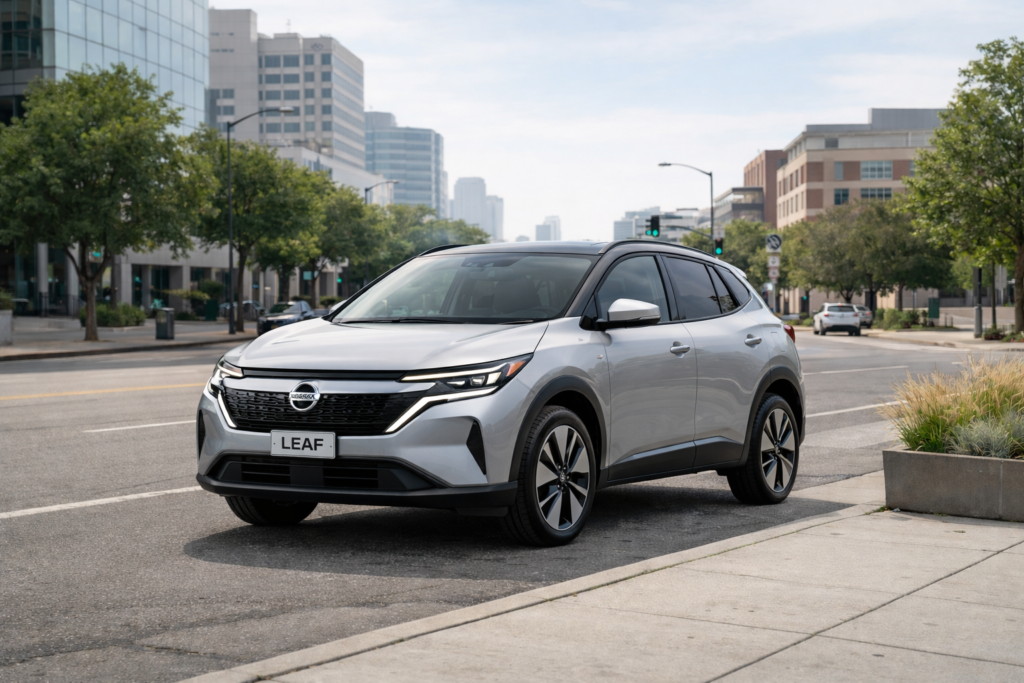
The thing that makes the Nissan Leaf stand out as a well-performed compact SUV is its impressive range. Whether it is cheap in price, it offers a wide range that makes it user-friendly and best for daily driving. The new model comes with advanced features like automatic emergency braking, lane-keeping assistant, and a rear camera that make it perfect.
Morething is that, the maintenance costs are less now, making it ideal for those who want a long-term vehicle, which is due to its electric powertrain. The Nissan Leaf offers smooth handling, instant torque, and a quiet driving experience for beginners. As a small SUV, the interior is quite spacious with a touch screen and advanced technologies.
Chevrolet Bolt EV
The best option for the cheapest electric SUVs, for the first-time buyer, should be Chevrolt bolt with no compromise on features and performance. The compact size, long range, and low price of the Bolt are the main factors to be favorable for beginners. With a smooth driving experience, hassle-free drive, and low maintenance cost, the Bolt is better than traditional fuel SUVs.

The main thing that makes the Bolt a better choice is its real-world range, which allows you to cover a long distance at single charge. The Chevrolet Bolt has an estimated range of 240 miles or more on a single charge, which removes the concern for those who do not want to frequent charging stations, instead taking a break on weekend trips.
With the fast charging capabilities, the Choverlet Bolt takes less time at charging stations, with more quality time on the road. This ability to charge quickly makes the Bolt ideal for beginners seeking a reliable, practical SUV. Another thing that makes the Bolt ideal is its advanced driving assistant system, like lane-keeping, emergency braking, and collision warning.
Kia Soul EV
The Kia Soul is one of the cheapest electric SUVs on the market, with its modern design and eye-catching looks. It is an amazing choice for buyers who are newly interacting with electric vehicles, who want a low budget, and a stylish SUV. The compact size and a high range make it ideal for city driving without any concern about running out of power.

With the smooth acceleration and instant torque, the Kia Soul delivers a seamless driving experience for beginners. A spacious interior, with more space, ensures comfort for both the driver and passengers, making it ideal for those who are seeking a compact SUV with more room for daily activities.
With the advanced technologies like a modern central touchscreen, auto-play, and Apple CarPlay, although at an affordable price, the Kia Soul is a perfect choice for new customers. The beginners who want more safety features, like collision warning, automatic emergency braking, and lane-keeping assistant, it is the best option.
Factors Affecting the Price of Electric SUVs
The main factors that affect the price of electric vehicles and make them the cheapest electric SUVs include their production, market demand, and technologies used in them. Brand and model are the main factors; brands like Tesla, BMW, and Audi offer high price dut to their reputation and more advanced technologies.

Instead of them, many new brands offer low-priced SUVs with well-balanced technology and performance. And more options make it easy for you to choose the affordable electric SUVs, which are explained below help you make the right decision.
Battery Size and Range of Cheapest Electric SUVs
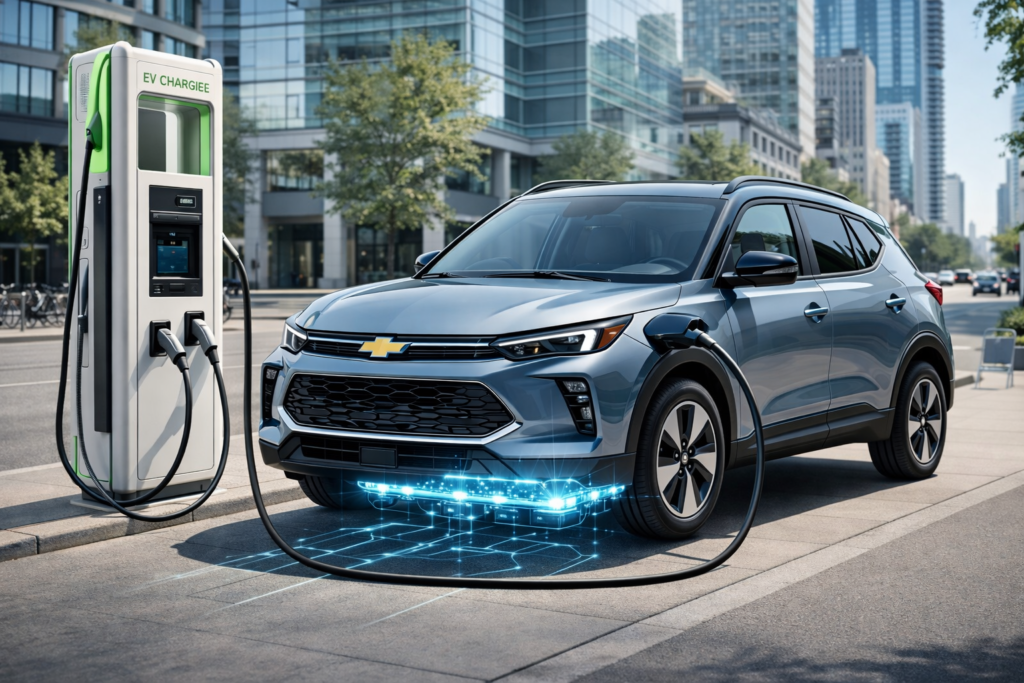
The two most important factors affecting the price of electric SUVs are the battery size and range. The battery size directly affects the range of an electric vehicle; with a larger battery, an electric SUV covers more distance because more power is supplied to the motors, and as a result, it becomes the cause of increasing the range.

When talking about the driving range of an electric SUV, it refers to the distance that it covers before any recharge. Almost everyone wants a vehicle with more range and reliability for covering long-distance areas with fewer stops for charging. The SUV with a range of 300 miles or more should be priced higher than the vehicles with a range of 150 to 200 miles should be priced lower.
Although the battery technology also matters in the price and performance of an electric SUV. The SUVs that use solid-state batteries that come with higher density and efficiency, which contribute to increasing the range, and have a low-weight battery are preferred more. But the new brands offer all these technologies, and that performs well with low prices.
Benefits of Driving the Cheapest Electric SUVs for Beginners
Driving the cheapest electric SUVs offers many benefits for beginners who are looking for an SUV with more features. There are many factors, such as the fact that the cheap SUV has a lower upfront cost that is compared to the traditional petrol and diesel cars or some higher-priced electric SUVs.
Driving the cheapest electric SUVs is beneficial for those who are seeking it for their first experience and do not want to empty their pockets. Hence, these things make a cheap SUV perfect for those who are new and wantto experience electric mobility. Some other aspects are explained below.
Low Running Costs of Cheapest Electric SUVs
The main benefit of choosing the cheapest electric SUV is its low running costs, and when compared to traditional petrol and diesel cars,s it is the best option. Some factors are explained below,w which shows how it impacts the owners:
- Lower fuel costs: The thing that makes an electric SUV better than any traditional gasoline car is its lower fuel consumption. With the charging methods, it costs less and is more beneficial.
- Few maintenance costs: An electric SUV has fewer parts moving than any other traditional vehicle, which means fewer parts will run out. With no need for regular oil changes and removed parts like the exhaust system, as a result, it costs less in maintenance.
- Energy efficiency: The electric SUVs are more efficient than other traditional vehicles because, instead of burning fuel, they are powered by a battery. These SUVs are the best options for those who are eco-friendly and have a low budget.

Eco-Friendly Driving Experience
The key thing about the cheapest electric SUVs is that they are more eco-friendly than other petrol and diesel cars, with zero emissions. And they do not contribute to the air pollution becoming ideal for those who are more conscious of the environment. They do not have any carbon footprint that states that they are fully nature-friendly.
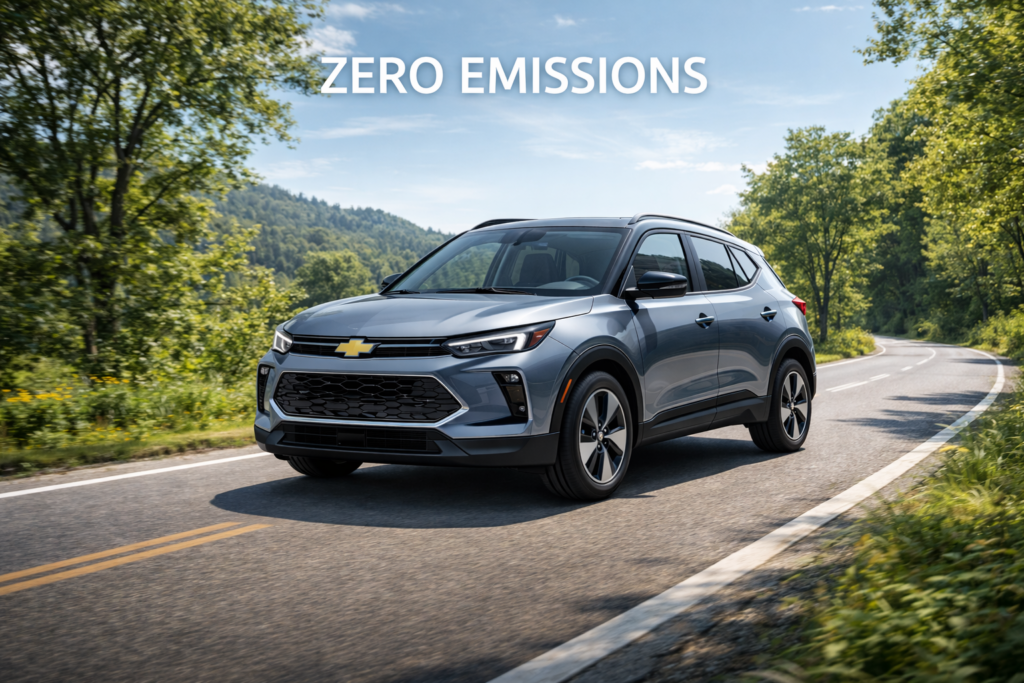
Another thing is battery recycling, which shows how much electric SUVs are eco-friendly. Many manufacturers are now investing in battery recycling companies and using these materials more responsibly. The plus point about electric vehicles is that they are quieter than traditional cars, which reduces noise pollution and delivers a quieter and smoother driving experience.
The electric SUVs are more supported by governments due to their zero emissions and are green certified. In addition, they have less incentive from the government, which makes them more affordable for beginners.
Safety Features of Cheapest Electric SUVs for Beginners
When moving to the cheapest electric SUVs, you should not forget about the safety features because your safety is more important than money. The features like adaptive cruise controls and traffic alert make you more focused on the road and provide perfect parking measurements.

The electric SUVs have low weight, and their center of gravity is maintained through the battery placement, which improves handling on the road, keeping it safe from rollovers, unlike other conventional SUVs.
Mostly, electric SUVs are built with crash test safety features and have many airbags protecting passengers in any accidental conditions. Many models come with highly visible rear cameras and parking sensors that help beginners to measure the estimated distance without any concern and be safe from scrapes.
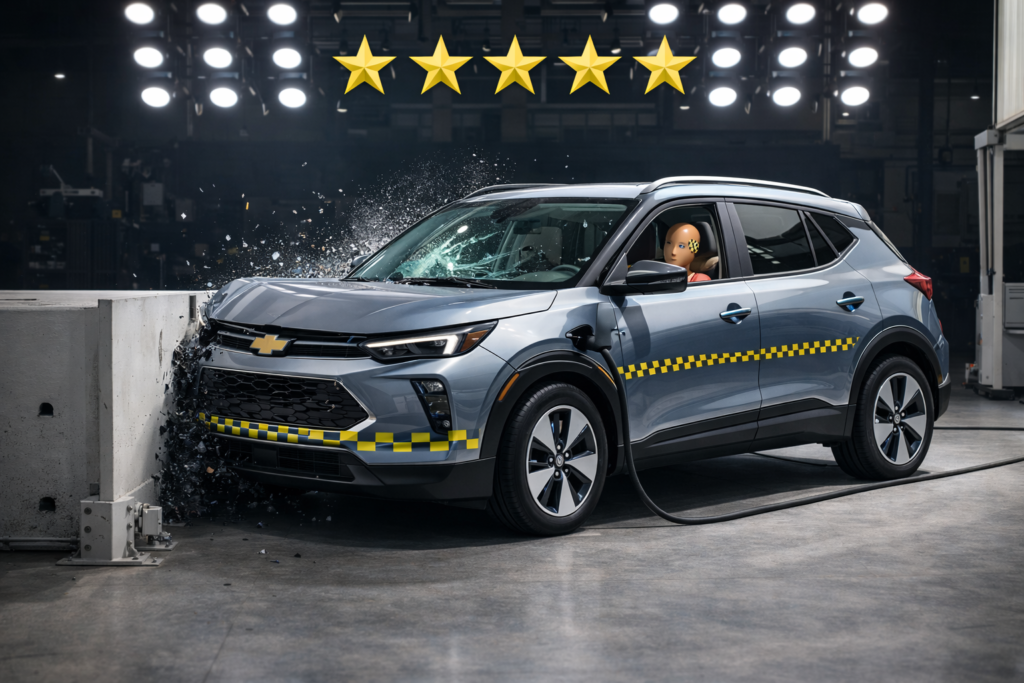
The advanced safety features, like the emergency braking system, lane-keeping assistant, and forward collision warning systems, help beginners to be safe and fully confident on the road. Investing in this type of cheapest electric SUV that is fully loaded with features, well-performing batteries, a good range for daily use, and that does not cost much in maintenance is worth it for you.
What is the cheapest electric SUV to buy?
From the research, the cheapest electric SUV is the Hyundai Kona, which is well-performed, has a spacious interior, and has quite a different and unique design.
What is the 80 20 rule for electric cars?
The 80 20 rule of electric cars simply explains that you should keep your vehicle charged between 20% to 80% to save your car’s battery health, which may last for the long term.
What is the cheapest electric SUV?
The leading electric car brand BYD has the electric SUV with a seating capacity of 4, the BYD Atto 1, and the second option BYD Atto 3, both of which are the best and cheapest electric SUVs with advanced technologies.
Conclusion
In this article, we have discussed facts about the cheapest electric SUVs, explaining the features that may be essential for beginners. As the market of electric vehicles continues to grow, there are many options for beginners, like the Nissan Leaf, Chevrolet Bolt, Kia Soul EV, and many more options.
When considering the cheapest electric SUVs, the key things safety features, battery and charging capabilities, long range, and low running costs should be in mind for better results. It does not matter which option you choose; the things about EVs are that they are eco-friendly, save you money on fuel, and have low maintenance costs.


Electric SUV towing capacity has transformed dramatically in 2026. And buyers who once assumed EVs could not tow are discovering a market full of powerful, capable options. Families planning road trips, outdoor adventurers hauling boats, and first-time EV buyers all share the same pressing question.
The best SUV for towing is no longer automatically a gas-powered truck or traditional body-on-frame SUV. Electric motors deliver instant torque from zero RPM, giving modern electric SUVs a significant pulling advantage over combustion alternatives of equivalent power ratings.
This guide covers every major electric SUV with a meaningful towing rating in 2026, from the GMC Hummer EV SUV’s class-leading 10,300-pound capacity to compact options suitable for light boat trailers and utility loads.
Can electric SUVs actually tow? The Truth Behind the Numbers
Electric SUVs not only tow several of the highest-towing vehicles on sale in 2026 but are also fully electric. Electric motors generate maximum torque from a complete standstill, which means launching a heavily loaded trailer from a dead stop feels effortless in a well-equipped electric SUV.
However, towing with an electric SUV introduces a specific challenge: energy consumption rises sharply when aerodynamic drag increases from a large trailer profile, and the battery pack bears the full burden of that additional load. This effect drives the range by 40 to 60 percent, depending on trailer size, highway speed, and wind conditions.

The good news is that the charging infrastructure supporting long-distance electric towing has improved significantly. Pull-through charging stations specifically designed to accommodate vehicles towing trailers are now available at major highway charging networks.
How EV Towing Capacity Works Differently From Gas SUVs?
Understanding electric SUV towing capacity requires recognizing the rating. This reflects a complex combination of structural limits, battery thermal management capabilities, brake system performance, and software-controlled power delivery, not simply motor output.
The factory tow package on any electric SUV is non-negotiable for serious towing. A proper factory tow package includes not only the hitch receiver and wiring harness but also critical software updates that modify the vehicle’s stability control, regenerative braking behavior, and battery cooling algorithms specifically for towing conditions.
Payload capacity represents another often-overlooked constraint. Tongue weight typically accounts for 10 to 15 percent of total trailer weight. A 7-seater electric SUV like the Kia EV9, carrying five adults with luggage, may have consumed a significant portion of its payload capacity before adding any trailer tongue weight.
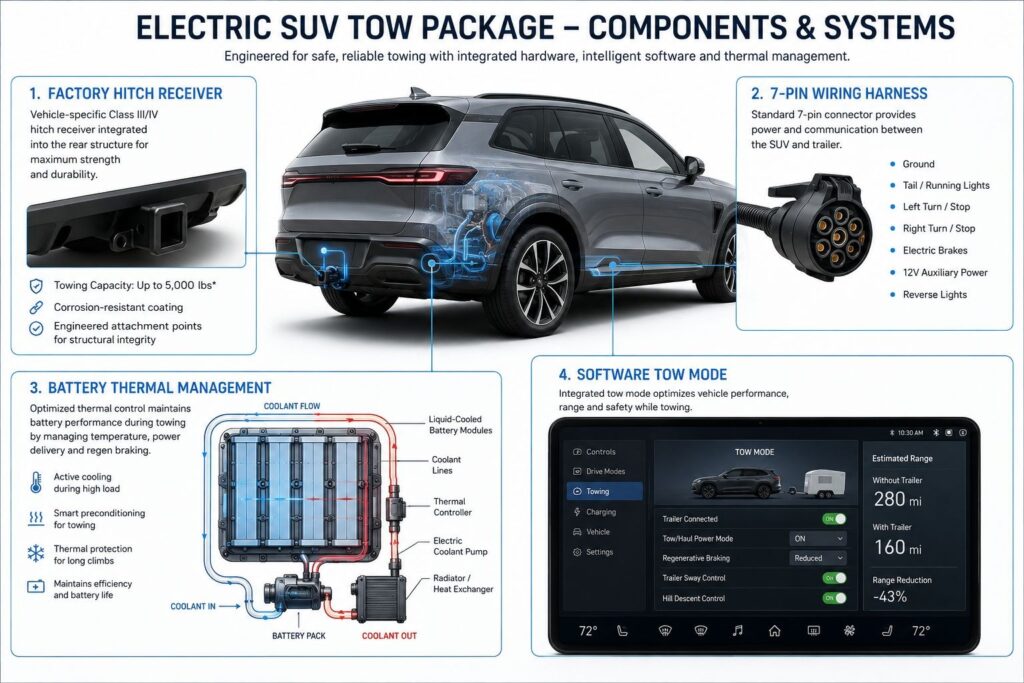
How much range do you lose when towing with an electric SUV?
Research from real-world towing tests consistently shows that attaching a typical travel trailer or enclosed cargo trailer at highway speeds reduces effective EV range by 40 to 60 percent. It means a 300-mile electric SUV becomes a 120-to-180-mile vehicle the moment a trailer connects. Aerodynamic drag accounts for the majority of this loss.
Wind speed and direction play a larger role in electric SUV towing range than most buyers initially anticipate, with strong headwinds capable of pushing range loss beyond 60 percent. Trailer design significantly affects the magnitude of this loss. A streamlined teardrop camper causes considerably less drag than a boxy enclosed utility trailer of similar weight.

A practical charging strategy for towing trips requires planning stops every 100 to 150 miles when towing heavy loads. The best long-distance electric car for towing combines a large battery pack with fast DC charging capability, ideally 150 kW or higher.
Electric SUV Towing Capacity Comparison: Top Models Ranked (2026)
You should always target an electric SUV whose maximum tow rating exceeds the trailer’s GVWR by at least 20 to 25 percent, providing a meaningful safety margin. Some top models are explained.
| Model | Max Tow Rating | Battery | Est. Tow Range | Best For |
| GMC Hummer EV SUV 2X | 10,300 lbs. | 212 kWh | Approximately 180 miles | Heavy trailers, 5th wheels |
| Rivian R1S (Max Pack) | 7,700 lbs. | 135 kWh | Approximately 150 miles | Adventure, off-road towing |
| Lucid Gravity | 6,000 lbs | 113 kWh | Approximately 170 miles | Long-range towing, luxury |
| Tesla Model X | 5,000 lbs | 100 kWh | Approximately 160 miles | Family campers, boats |
| Kia EV9 AWD | 5,000 lbs | 99.8 kWh | Approximately 150 miles | 7-seat family + caravan |
| Rivian R1S (Standard) | 5,000 lbs | 105 kWh | Approximately 140 miles | Families, light adventure |
| Volvo EX90 | 4,850 lbs. | 111 kWh | Approximately 150 miles | 3-row family towing |
| Audi Q8 e-tron | 4,000 lbs | 114 kWh | Approximately 160 miles | Premium daily + towing |
| Tesla Model Y AWD | 3,500 lbs. | 82 kWh | Approximately 120 miles | Small boats, utility |
| BMW iX xDrive60 | 3,500 lbs. | 111 kWh | Approximately 150 miles | Light towing, premium |
| Hyundai Ioniq 5 AWD | 3,500 lbs. | 84 kWh | Approximately 120 miles | Light trailers, compact |
| Ford Mustang Mach-E | 2,000 lbs | 98 kWh | Approximately 130 miles | Very light loads only |
Best Electric SUVs for Heavy Towing in 2026
GMC Hummer EV SUV: The Towing King at 10,300 lbs.
The GMC Hummer EV SUV 2X claims the title of the highest-towing electric SUV, with a maximum towing capacity of 10,300 pounds. This capability comes from a 212 kWh battery pack, the largest in any passenger EV currently on sale, combined with a dual-motor powertrain producing 570 horsepower and an active air suspension system.
The Hummer EV’s 800-volt electrical architecture supports DC fast charging at up to 350 kW, meaning a 10-to-80-percent charge takes approximately 25 minutes at a compatible station. However, the Hummer EV SUV weighs approximately 9,640 pounds, heavier than some of the trailers buyers plan to tow with it.
Rivian R1S: Best Adventure Electric SUV for Towing
The Rivian R1S delivers up to 7,700 pounds of towing capacity in its Max Pack configuration. Rivian’s proprietary towing software actively monitors trailer sway, automatically applying individual wheel braking to stabilize the combination without driver intervention.
Rivian’s Adventure Network charging infrastructure has expanded significantly in previous years, with many stations now featuring pull-through configurations that accommodate vehicles towing trailers.
Kia EV9: Best Family Electric SUV for Towing
The Kia EV9 AWD combines a 5,000-pound tow rating with genuine three-row luxury and seats seven adults comfortably, making it the most balanced electric SUV for families who need both passenger capacity and meaningful towing capability.
The EV9’s 800-volt charging architecture enables DC fast charging at up to 240 kW, allowing families to add approximately 100 miles of range in under 15 minutes. Kia backs the EV9 with a class-leading 10-year, 100,000-mile warranty on the battery and drivetrain.
What to Look for in an Electric SUV Before Towing?
Every one of you must verify the factory tow package before purchase. A proper factory tow package modifies the vehicle’s brake bias, regenerative braking thresholds, stability control sensitivity, battery cooling behavior, and suspension tuning. If you are discovering a compatible aftermarket hitch receiver for an EV not officially rated for towing, you should avoid installation.
A family of five weighing approximately 850 pounds collectively, combined with 200 pounds of camping gear and a trailer tongue weight of 400 pounds from a 3,500-pound camper, consumes 1,450 pounds of payload capacity, a figure that exceeds the payload rating of several popular electric SUVs.

You should specifically prioritize electric SUVs equipped with a Tow/Haul drive mode, integrated trailer sway detection, and a built-in trailer brake controller when selecting a vehicle for regular towing duties.
How to Manage Range Anxiety When Towing With an EV?
Experienced EV towers consistently recommend applying a 50 percent range reduction to the vehicle’s EPA-rated range as the planning baseline for highway towing with a large trailer, then identifying charging stops every 100 to 120 miles along the route.
PlugShare, a better route planner, and manufacturer-specific navigation systems updated for 2026 now incorporate trailer dimensions and weight into route calculations, automatically identifying pull-through charging stations large enough to accommodate a towing combination.
Destination charging at campgrounds, marinas, and outdoor recreation facilities has expanded significantly this year. Overnight charging at a campground with a 50-amp Level 2 outlet can restore 60 to 80 percent of an electric SUV’s battery capacity in eight hours.

Electric SUVs That Cannot Tow and Why
Several popular electric SUVs carry a zero towing rating despite their impressive size and power output. The Volkswagen ID.4, Hyundai Ioniq 6, Polestar 2, and several trim variants of the Tesla Model 3 officially carry zero towing ratings in North American markets.
This discrepancy arises because North American homologation requires specific crash safety testing for towing configurations, and manufacturers choose not to pursue this certification for vehicles they do not position as primary towing choices.
Always verify the towing specification in the North American owner’s manual and on the vehicle’s door jamb label. An aftermarket hitch on a zero-rated EV not only creates a serious safety liability but also immediately voids the vehicle’s powertrain warranty.
Is an Electric SUV Good Enough for Your Towing Needs?
Families towing a 3,500-pound boat to a lake 80 miles from home will find the Tesla Model Y, Kia EV9, or Hyundai Ioniq 5 entirely sufficient. In contrast, if you are towing a 6,500-pound fifth wheel on 400-mile road trips, you should focus exclusively on the GMC Hummer EV SUV or Rivian R1S with the Max Pack.
The electric pickup truck market, including the Rivian R1T, Ford F-150 Lightning, and GMC Sierra EV, offers an alternative worth considering for you, whose primary use case is heavy towing.
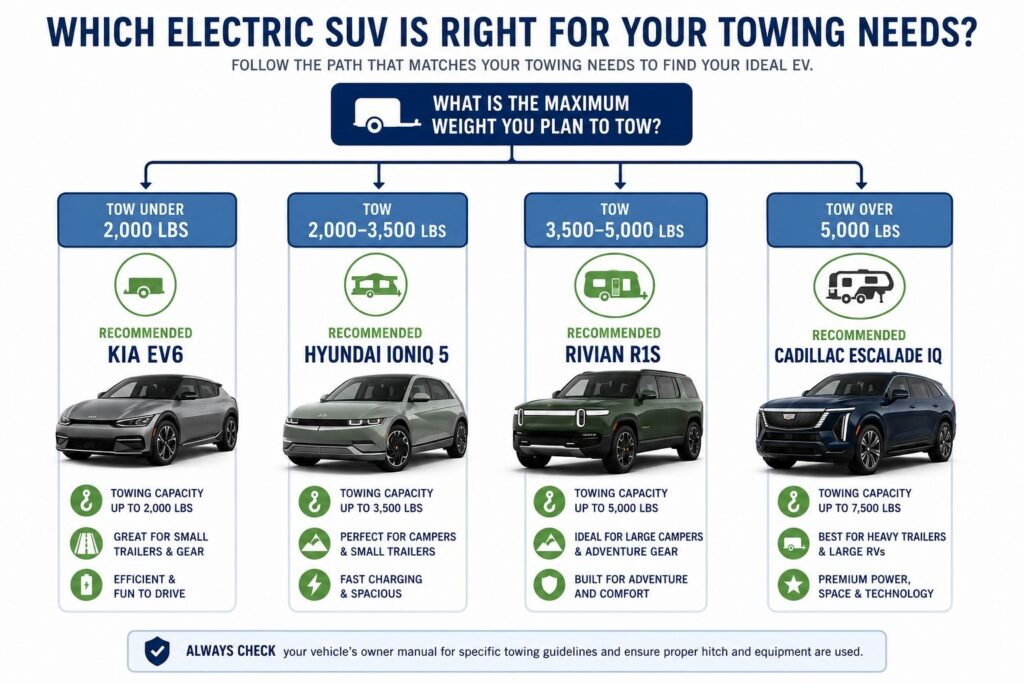
However, families who need daily versatility, seven-seat passenger capacity, and refined ride quality alongside meaningful towing capability will find the Kia EV9 and Rivian R1S the most complete solutions available.
Which EV SUV has the highest towing capacity?
The GMC Hummer EV SUV 2X leads all electric SUVs this year with a maximum towing capacity of 10,300 lbs, making it the most capable EV for heavy trailer towing currently available on the market.
What EV can tow 1800 kg?
Several electric vehicles can tow 1,800kg (around 3,968 lbs), including the Kia EV9, Tesla Model Y, Audi Q4 e-tron, and Hyundai IONIQ 5. These EVs offer strong towing capability while maintaining good electric range and everyday practicality. Always check the exact towing rating based on the vehicle trim and battery configuration before towing heavy loads.
Which EV is best for towing?
The Rivian R1S is considered one of the best EVs for towing because of its powerful performance, high towing capacity of up to 7,700 pounds, and excellent off-road capability. For drivers who need a balance of towing strength, electric range, and utility, it stands out as a top electric SUV choice.
What is the towing capacity of BYD?
The towing capacity of BYD electric vehicles varies by model. Popular models like the BYD Sealion 7 and BYD Tang EV can tow between 1,500kg and 1,800kg, depending on the variant and market specifications. Always check the official BYD specifications for your region, as towing capacity may differ by trim level and battery configuration.
Conclusion
Electric SUV towing capacity in 2026 has evolved to the point where the right EV genuinely replaces a gas SUV for the vast majority of towing scenarios. The GMC Hummer EV SUV leads the segment with 10,300 pounds of capacity.
The Rivian R1S delivers the most purpose-built adventure towing experience, and the Kia EV9 remains the definitive family electric SUV for those who need seven seats alongside meaningful trailer capability.
Families and outdoor adventurers considering their first electric towing vehicle should prioritize battery capacity above 100 kWh, DC fast charging above 150 kW, and an officially rated factory tow package as non-negotiable selection criteria. The electric towing revolution is already here.
Electric SUV Buying Guide
How to Check Used Electric SUV Battery Health Before Buying: Complete Guide

Buying a used electric SUV is one of the smartest financial decisions a car buyer can make in 2026, but only when the buyer understands one critical factor: used electric SUV battery health. Unlike traditional combustion engines, an EV’s battery pack directly determines its range, performance, and long-term reliability.
Many used EV buyers focus entirely on mileage, exterior condition, and price, completely overlooking the battery, which is the single most expensive component in any electric SUV. Battery replacement costs can range, estimated from $8,000 to $22,000, depending on the model, making it absolutely essential to verify battery health before signing any agreement.
This complete guide covers everything you need to know about used electric SUVs battery health, from decoding State of Health percentages to testing real-world range, reading brand-specific battery reports, and knowing exactly when to walk away from a bad deal.
Why Battery Health Is the Most Important Factor in a Used Electric SUV
The battery pack in an electric SUV functions as both the fuel tank and the engine simultaneously, making it fundamentally different from any component in a conventional vehicle. In most modern electric SUVs, the battery pack represents 30 to 40 percent of the vehicle’s total value.
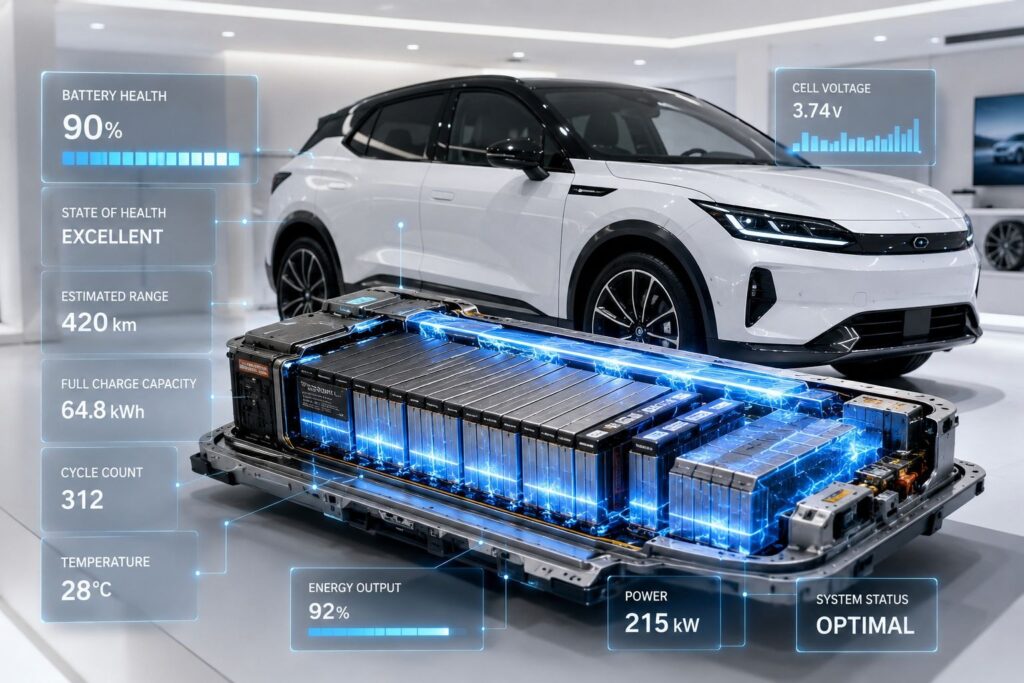
This means battery degradation directly translates into financial loss for you. A car that looks perfect on the surface can carry a battery that delivers 20 percent less range than its original specifications, and most sellers will never volunteer this information upfront.
Electric vehicle battery lifespan follows a natural but manageable decline over time, and the rate of that decline depends heavily on how the previous owner charged and drove the vehicle. Frequent DC fast charging, exposure to extreme heat without proper thermal management, and consistently charging to 100 percent all accelerate battery capacity loss faster than normal use.
What Is “State of Health” (SOH), and Why Must Every EV Buyer Know It?
State of Health, universally abbreviated as SOH, is the single most important number any used electric SUV buyer needs to understand before making a purchase. SOH represents the battery’s current usable capacity expressed as a percentage of its original factory capacity; a battery with 88 percent SOH can store approximately 88 percent of the energy.
Battery health percentage naturally declines over time as lithium-ion cells go through repeated charge and discharge cycles, and this process is completely normal in all electric vehicles. Most modern electric SUVs are engineered to retain at least 70 percent SOH over eight years or 100,000 miles.

How SOH Differs From State of Charge (SOC)?
State of Charge, or SOC, is the everyday battery gauge; it shows how much energy currently sits in the battery pack, exactly like a fuel gauge in a traditional vehicle. SOC fluctuates constantly as the driver charges and discharges the battery during normal use, ranging from zero percent when completely empty to 100 percent when fully charged.
SOH measures the battery’s permanent, long-term capacity relative to its original factory specification, and it only decreases over time, never recovering during normal use. A vehicle showing 95 percent SOC on the dash simply means the battery is nearly full right now, but it reveals nothing about whether that battery can hold 95 percent of its original maximum capacity.
What Is a Good SOH Percentage for a Used Electric SUV?
Industry data and your experience consistently show that a used electric SUV with SOH above 85 percent represents an excellent purchase, delivering near-original range performance with many more years of healthy battery life ahead. Vehicles in the 80 to 85 percent SOH range remain solid choices.
If you approach any used electric SUV showing SOH below 75 percent with extreme caution, regardless of how attractive the listed price appears on the surface. A battery at this level may already be approaching the manufacturer’s replacement threshold, which could trigger a costly out-of-pocket expense very soon after purchase if the original warranty has expired.
Top Warning Signs of a Degraded Electric SUV Battery
Recognizing the visible warning signs of a degraded EV battery empowers you to identify problems before spending money on formal diagnostics. The most obvious signal is a significant gap between the vehicle’s displayed estimated range and its original EPA-rated range; a model rated at 300 miles showing only 220 miles on a full charge represents a serious red flag.
Inconsistent battery percentage readings during charging sessions indicate potential issues with the battery management system or underlying cell degradation that standard checks might not immediately reveal.
Sellers who refuse to provide charging history records, cannot produce service documentation, or become defensive when asked about battery diagnostics should raise immediate suspicion in any serious buyer.
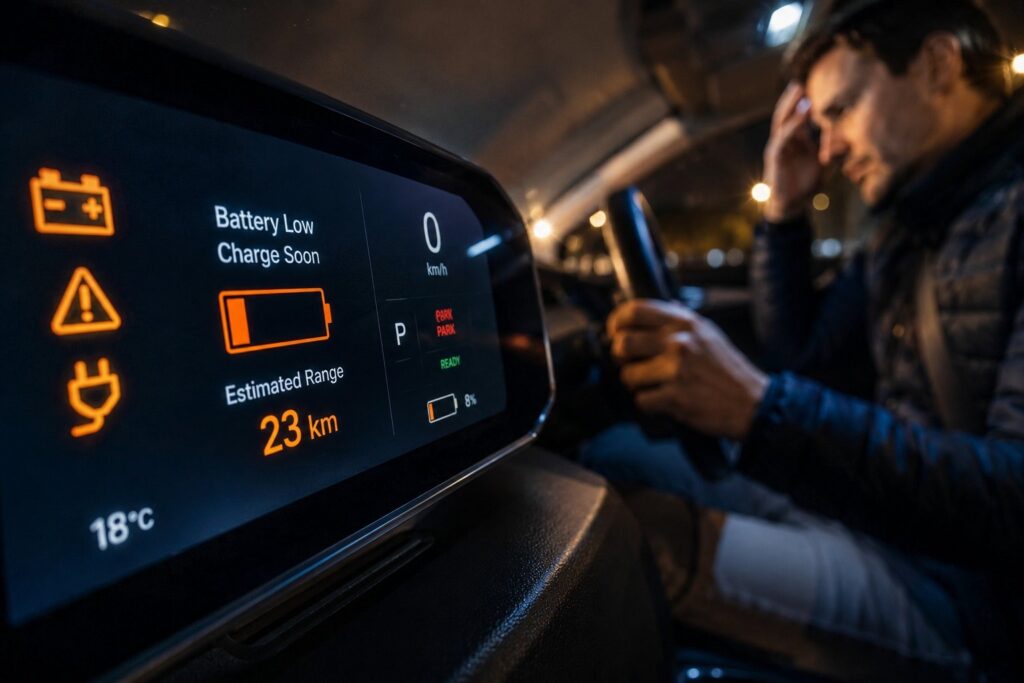
6 Proven Methods to Check Battery Health Before You Buy
If you are a serious buyer of a used electric SUV, you must apply at least two or three of the following methods before finalizing any purchase decision. Relying on a single source, such as a seller’s verbal assurance, creates unnecessary risk in a transaction involving tens of thousands of dollars.
The methods below range from completely free to professional-grade diagnostics, and combining multiple approaches provides the most complete and reliable picture of the battery’s true condition.
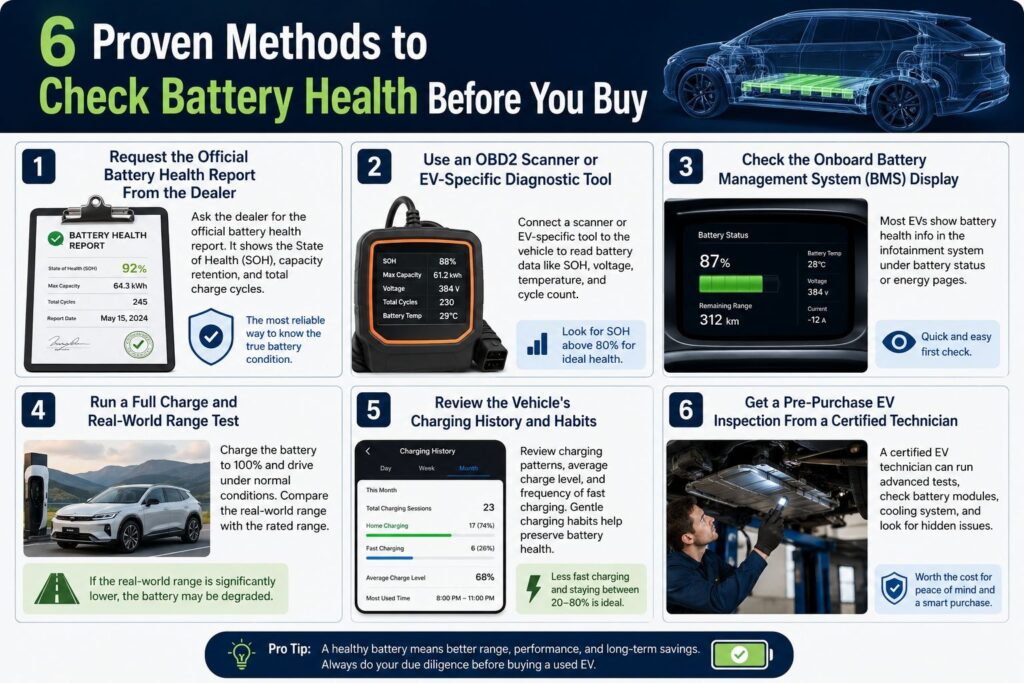
1. Request the Official Battery Health Report From the Dealer
Reputable dealerships and certified used EV platforms provide formal battery health reports generated directly from the manufacturer’s diagnostic system, and you should always request this document as the very first step.
For private-party sales, you can request that the seller take the vehicle to an authorized dealership for an official battery health diagnostic, with the buyer covering the modest inspection fee in exchange for receiving a verified written report. This approach works particularly well for Tesla, BMW, and BYD electric SUVs.
2. Use an OBD2 Scanner or EV-Specific Diagnostic Tool
An OBD2 scanner for electric cars provides you with direct access to real-time battery data by connecting to the vehicle’s onboard diagnostic port, typically located beneath the steering column. EV-specific OBD2 tools priced between $30 and $150 can read SOH, SOC, individual cell voltages, battery temperature, and charging cycle count.
You should always compare OBD2 scanner readings against the manufacturer’s published specifications for that specific model year to determine whether degradation falls within normal parameters. A five-year-old electric SUV showing 88 percent SOH represents excellent performance.
3. Check the Onboard Battery Management System (BMS) Display
The battery management system built into most modern electric SUVs continuously monitors cell-level performance, temperature, voltage balance, and overall capacity. And many vehicles now display this information directly through their infotainment touchscreen.
Even in vehicles where the BMS does not display an explicit SOH percentage, the system often reveals indirect indicators. Such as reduced maximum charge capacity, unusual temperature warnings, or cell imbalance alerts that signal underlying degradation.
4. Run a Full Charge and Real-World Range Test
The real-world range test remains one of the most practical and reliable methods available for you without specialized equipment, requiring nothing more than a full charge and a measured driving route.
For a more precise evaluation, you can drive a flat, consistent route at normal speeds while monitoring the energy consumption rate displayed on the dashboard. Calculate the implied full-pack range by dividing the distance driven by the percentage of battery consumed. Driving 38 miles while consuming 30 percent implies a full-pack range of approximately 126.7 miles.
5. Review the Vehicle’s Charging History and Habits
DC fast charging battery damage accumulates gradually but consistently, and reviewing a vehicle’s charging history provides critical insight into how aggressively the previous owner treated the battery.
Many modern electric SUVs, particularly Tesla models, maintain detailed in-vehicle charging logs accessible through the infotainment system or the manufacturer’s companion app, showing frequency and power levels of past charging sessions.
6. Get a Pre-Purchase EV Inspection From a Certified Technician
A certified EV technician inspection represents the gold standard of used electric SUV battery health verification, combining professional-grade diagnostic software with hands-on physical examination of the battery pack and its supporting systems.
You should specifically request an EV-certified technician rather than a general automotive mechanic, as the diagnostic procedures required for accurate electric vehicle battery assessment differ significantly from conventional inspection methods.
How Different Brands Handle Battery Health (Tesla, BMW & BYD)
Understanding how each major electric SUV brand approaches battery health monitoring helps you to ask the right questions and access the right data for each specific vehicle they evaluate. Tesla, BMW, and BYD. Each implements distinct battery management architectures and reporting systems that you must navigate differently.
Tesla’s Battery Report: What It Shows
Tesla electric SUVs offer one of the most transparent battery health reporting systems in the industry, accessible directly through the vehicle’s touchscreen under Settings > Service > Battery.
For older Tesla models without the formal Battery Health Test feature, you can still access meaningful data through the displayed maximum range after a full charge, which serves as a reliable proxy for overall battery condition.
BMW Electric SUVs: How to Read Battery Data
BMW electric SUVs, including the iX and iX1 models, integrate battery health monitoring directly into the iDrive infotainment system, allowing you to access diagnostic data without any external tools during a standard test drive.
BMW provides an 8-year or 100,000-mile battery capacity warranty on all its electric SUV models, guaranteeing retention of at least 70 percent of original capacity within that coverage period. When you are considering used BMW iX or iX1 models, you should specifically request a BMW check report from an authorized dealership.
BYD Electric SUVs: Built-In Battery Monitoring
BYD electric SUVs, including the Atto 3, Sealion 6, and Tang, benefit from the brand’s proprietary Blade Battery technology, a lithium iron phosphate design that demonstrates significantly lower degradation rates compared to the nickel-manganese-cobalt chemistry used in many competing electric SUVs.
BYD’s companion app provides owners with access to battery status information, including current capacity, charging session records, and basic health indicators, all of which you should request during any pre-purchase evaluation.
| Brand | Battery Type | Avg. Degradation Per Year | Warranty | Best Diagnostic Method |
| Tesla | NCA / LFP (SR) | 1.8 to 2.3% | 8 yr / 100K to 150K mi | Built-in Battery Health Test |
| BMW | NMC Li-ion | 2.0 to 2.5% | 8 yr / 100K mi | BMW Check Report (Dealer) |
| BYD | LFP Blade Battery | 1.2 to 1.6% | 8 yr / 150K km | BYD App + Service Center |
How Fast Does an Electric SUV Battery Actually Degrade?
Geotab’s 2026 fleet analysis of over 22,700 electric vehicles reveals that the average battery degradation rate has increased to 2.3 percent per year, up from 1.8 percent in 2024, primarily driven by a significant increase in DC fast charging frequency across the broader EV population.
Battery chemistry plays a profound role in determining how quickly an electric SUV battery degrades over time, and you should understand the key differences between the two dominant technologies currently in the used market. LFP batteries are used in BYD’s entire electric SUV lineup and in Tesla’s standard range variants.
The most impactful single decision within any EV owner’s control is charging behavior, and the evidence from large fleet datasets is unambiguous: reducing DC fast charging frequency preserves battery health more effectively than any other single variable.

Is a Used Electric SUV With Battery Degradation Still Worth Buying?
A used electric SUV showing measurable battery degradation can absolutely represent an excellent purchase when you understand the numbers, negotiate appropriately, and select a vehicle whose remaining capacity still meets your actual daily driving requirements.
You should calculate the implied range at the vehicle’s current SOH and compare it against their realistic maximum daily driving needs before dismissing a degraded battery as unacceptable. A The Tesla Model Y, originally rated at 330 miles, showing 82 percent SOH, delivers approximately 271 miles of rated range.
EV battery replacement cost represents the ultimate financial risk every used electric SUV buyer must factor into their calculation, as this expense can range from $8,000 for smaller models to over $22,000 for large luxury platforms.
Does the Battery Warranty Transfer When You Buy Used?
EV battery warranty transfer policies vary significantly between manufacturers, and you must verify the specific terms for any used electric SUV model before finalizing a purchase. Most major manufacturers, including Tesla, BMW, and BYD, do transfer the remaining battery warranty to subsequent owners.
Tesla’s battery warranty covers 8 years or between 100,000 and 150,000 miles depending on the model variant, guaranteeing at least 70 percent retention of original capacity, and this warranty transfers fully to subsequent private buyers.
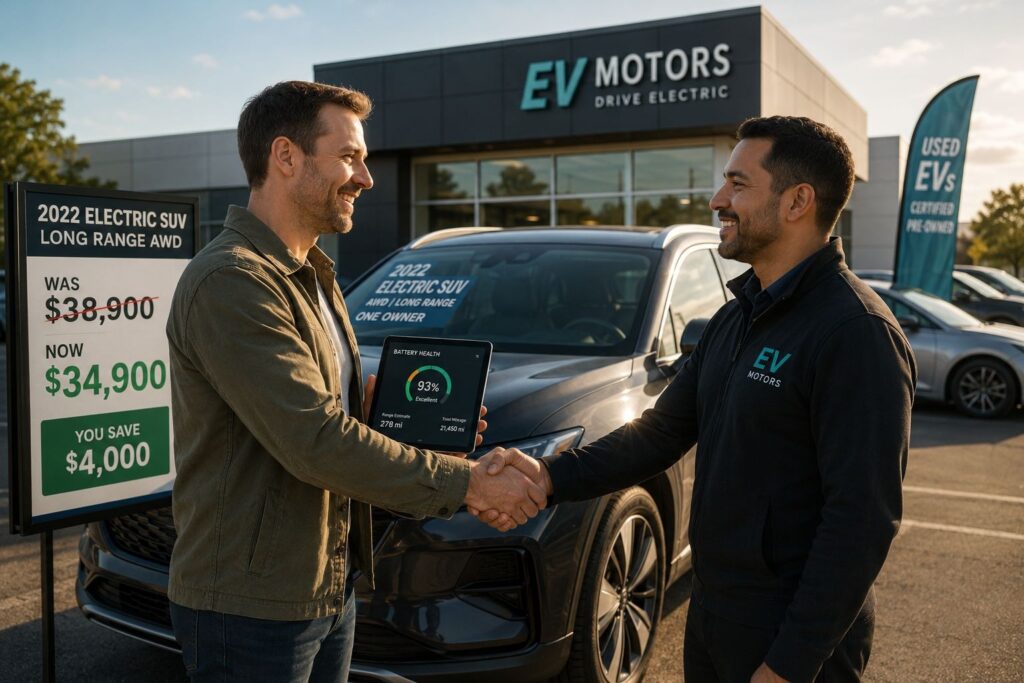
BMW provides equivalent 8-year, 100,000-mile battery coverage that transfers to new owners, while BYD’s Blade Battery warranty extends to 8 years or 150,000 kilometers with similar capacity retention guarantees. When you are purchasing used electric SUVs outside of certified pre-owned programs, you should request written confirmation of the remaining warranty.
Quick Pre-Purchase Battery Health Checklist
Before committing to any used electric SUV purchase, you should systematically work through this verification checklist to ensure complete confidence in the battery’s condition and overall transaction value.
Missing even one of these verification steps creates unnecessary financial exposure in a purchase where the battery alone represents 30 to 40 percent of the vehicle’s total value.
- Request the official battery health report from the dealer or manufacturer service center
- Verify SOH percentage, target 85% or above; negotiate below 85%; walk away below 75%
- Check the BMS display in the vehicle’s infotainment system for built-in health indicators
- Run an OBD2 scanner to independently verify SOH, cell voltages, and charging cycle count
- Perform a full-charge range test and compare against the original EPA-rated range figure
- Review the vehicle’s charging history, check for excessive DC fast charging sessions
- Inspect for any battery-related warning codes in the vehicle’s fault history
- Confirm the remaining battery warranty period and verify that it transfers to new owners
- Research EV battery replacement cost for the specific model before finalizing any offer
- Engage a certified EV technician for a professional pre-purchase inspection on high-value purchases
- Compare the seller’s asking price against current market values adjusted for verified SOH.
- Never purchase a used electric SUV without at least two independent battery health confirmations.

How to tell the health of a battery in a used EV?
You can check the health of a battery in a used EV by reviewing the battery’s State of Health (SOH) report, testing the driving range, and using EV diagnostic tools. A healthy battery should retain most of its original capacity and deliver stable performance during charging and driving.
What is the life of a used electric car battery?
Most used electric car batteries last between 10 and 15 years or around 100,000 to 200,000 miles, depending on driving habits and charging practices. Many modern EV batteries still retain good performance even after years of regular use.
How good is the battery in a used electric vehicle?
The battery in a used electric vehicle can still be very reliable if it has been properly maintained and regularly charged under healthy conditions. Most modern EV batteries retain a large percentage of their original capacity even after several years of use.
Is 90% battery health normal after 1 year?
Yes, around 90% battery health after 1 year can be normal for some electric vehicles, especially if the car is frequently fast-charged or driven in extreme temperatures. However, many well-maintained EVs still retain more than 90% battery capacity after the first year.
Conclusion
Used electric SUV battery health is the single most important factor any of you must evaluate before committing to a pre-owned EV purchase in 2026, and the tools, methods, and knowledge required to assess it accurately are more accessible than ever before.
The used EV market offers extraordinary opportunities for those who do their homework, providing vehicles that cost 35 to 40 percent less than new while delivering most of the same performance, technology, and efficiency.
For more expert guidance on finding the best used electric SUV for your budget and driving needs, explore the Used Electric SUVs buying guide and the complete brand-by-brand reviews covering Tesla, BMW, and BYD electric SUVs available throughout this site, and return here whenever a battery health question comes up before your next EV purchase.

Electric SUVs are dominating the automotive market in 2026, and for good reason. They combine practicality, modern technology, and lower running costs into one compelling package. For beginners, the best entry-level electric SUVs provide an accessible way to switch from petrol to electric driving.
Manufacturers are rapidly expanding their EV lineups due to increasing demand. From affordable family cars to premium performance SUVs, there is now something for everyone. As a result, first-time buyers have more choices than ever.
However, with so many options available, choosing the right electric SUV can feel overwhelming. Factors like range, charging speed, and real-world usability play a crucial role in the decision-making process.
Benefits of Buying an Entry-Level Electric SUV
Entry-level electric SUVs strike the perfect balance between affordability and functionality. Unlike premium models such as the BMW iX or Porsche Macan EV, they focus on delivering essential features at a lower cost.
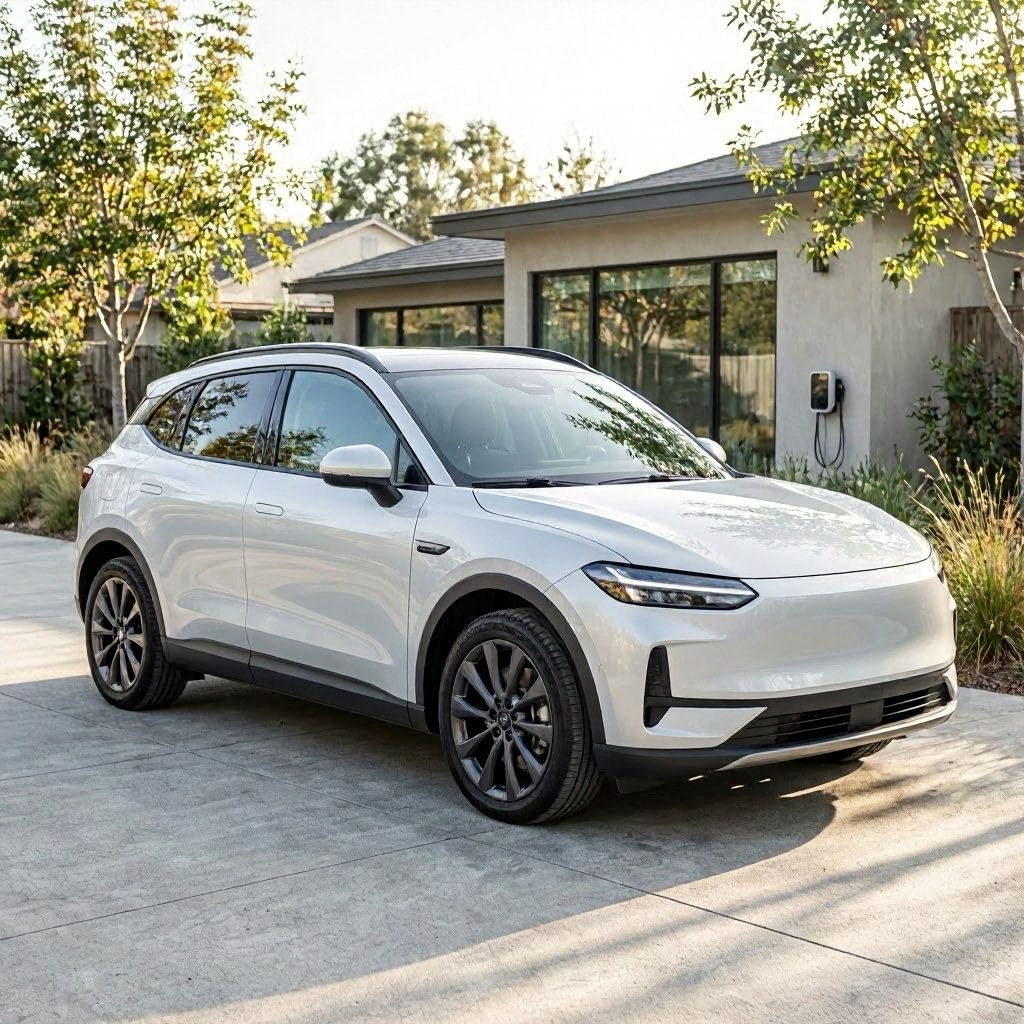
Moreover, SUVs naturally complement electric platforms. Their larger size allows manufacturers to fit bigger batteries without sacrificing cabin space. As a result, they often provide better range and practicality than smaller EVs.
Lower Purchase Cost
Entry-level electric SUVs are designed to be budget-friendly. Models like the Hyundai Kona electric, Kia Niro EV, and Kia EV3 offer excellent value compared to high-end alternatives and have most of the advanced features, like advanced driving assistance systems, adaptive cruise control, and collision warning, at lower prices.

Additionally, government incentives and tax benefits can significantly reduce the purchase price. In many regions, EV buyers also avoid extra urban charges. Therefore, switching becomes financially attractive and makes it easier for you.
Modern Technology and Safety Features
Even affordable electric SUVs now include advanced features. Adaptive cruise control, lane assist, and large infotainment systems are commonly standard. For example, newer models integrate multi-screen displays and connected apps. Over-the-air updates also ensure the vehicle improves over time. Consequently, you can get long-term value.
Lower Maintenance and Running Costs
Electric SUVs require less maintenance than traditional vehicles. There’s no oil change, fewer moving parts, and reduced wear. Moreover, charging costs are also lower than fuel expenses. Home charging overnight can significantly cut daily running costs. As a result, your ownership becomes more budget-friendly over time.
Key Factors to Consider Before Buying an Entry-Level Electric SUV
Buying your first electric SUV requires careful evaluation. Not all models perform equally in real-world conditions. Therefore, understanding key factors is essential for you to make a strong decision. Expert testing shows that range, charging, and practicality matter most. These directly affect your daily experience and long-term satisfaction.

Driving Range and Battery Capacity
Most entry-level electric SUVs offer between 250 and 400 kilometers of range. However, real-world conditions can impact these numbers. Moreover, cold weather, high speeds, and heavy loads reduce efficiency. Therefore, you should always consider realistic driving scenarios when choosing a model.

Charging Speed and Infrastructure
Charging speed is critical for your convenience. Modern EVs now support rapid charging, often reaching 80% in under 40 minutes or less with the help of stronger power. Infrastructure is expanding quickly. Brands like Tesla lead with dedicated networks, while public chargers are becoming more widespread. Consequently, long-distance travel is becoming easier.
Performance and Driving Experience
Electric SUVs deliver smooth and instant acceleration. Even entry-level models feel responsive compared to petrol cars. Additionally, their low center of gravity improves handling. This creates a stable and comfortable ride. As a result, driving feels modern and refined.
Design and Tech features
Modern electric SUVs combine futuristic design with practical functionality. Clean lines, LED lighting, and aerodynamic shapes define their look. Inside, manufacturers focus on minimalism and usability. This improves driver experience while maintaining a premium feel.

Interior Features and Technology
Most models include large touchscreens, smartphone integration, and voice controls. Systems like Apple CarPlay and Android Auto are standard. For example, some SUVs now feature triple-screen setups and advanced navigation systems. These enhance convenience and connectivity.

In addition, electric SUVs offer generous interior space due to flat-floor architecture. This improves legroom and comfort. Additionally, quiet electric motors reduce noise and vibration. As a result, long journeys feel more relaxing.
Safety Ratings and Reliability
Safety is a strong focus in EV design. Many entry-level SUVs achieve top safety ratings with advanced driver assistance systems. Reliability is improving as EV technology matures. Fewer mechanical parts mean fewer failures. Therefore, your ownership becomes more dependable.
Best Entry-Level Electric SUVs in 2026 (Top Picks)
Selecting the best entry-level electric SUVs in the modern era involves striking a balance between range, price, and everyday usability. Based on real-world testing and current market trends, several models consistently stand out for first-time EV buyers.
These SUVs are not just affordable; they are practical for daily life. They offer reliable battery performance, comfortable interiors, and enough technology to feel modern without being overwhelming.
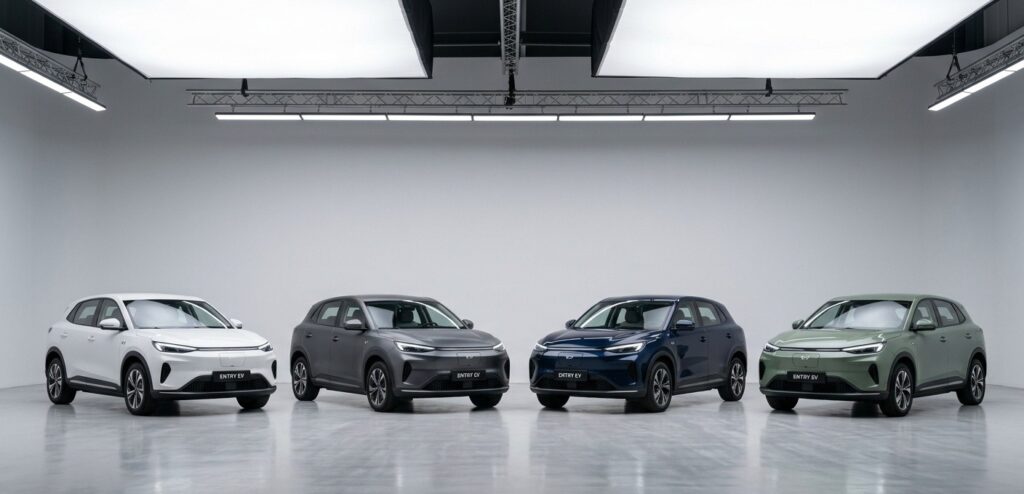
Furthermore, numerous models utilize established EV platforms, guaranteeing enhanced efficiency and reduced long-term problems. Below are the top picks that deliver the best mix of value, performance, and ownership experience.
Hyundai Kona Electric
The Hyundai Kona Electric remains one of the most dependable entry-level EV SUVs. It offers a real-world range of around 300 miles in higher trims, making it suitable for both city driving and occasional long trips.
From an ownership perspective, the Kona excels in efficiency. Many drivers report consistent energy consumption even in mixed driving conditions. Additionally, Hyundai’s refined battery management system helps maintain performance across different climates.

Inside, the Kona features a clean dual-screen layout with intuitive controls. While it may not feel ultra-premium, it prioritizes usability. Therefore, it is ideal for first-time buyers who want a simple, reliable experience.
Chevrolet Bolt EUV
The Chevrolet Bolt EUV stands out as one of the most budget-friendly electric SUVs available. Despite its lower price, it delivers a practical range of around 250 to 270 miles, which is sufficient for most daily needs.
In real-world use, the Bolt EUV is particularly strong in any environment. Its compact size makes parking effortless, while its smooth acceleration improves stop-and-go traffic driving. However, it lacks ultra-fast charging compared to newer competitors.

The interior is functional rather than luxurious, but it includes essential tech like a responsive infotainment system and driver assistance features. As a result, it’s a smart choice for cost-conscious buyers entering the EV market.
Kia Niro EV
The Kia Niro EV offers a well-rounded package focused on comfort and efficiency. It delivers a real-world range close to 280 to 300 miles, making it suitable for both daily commutes and longer drives.
One of its strongest points is practicality. The cabin is spacious, with ample legroom and a well-designed layout. Additionally, Kia has improved material quality, giving it a more premium feel than many competitors in this segment.

From an ownership standpoint, the Niro EV is easy to live with. Its smooth ride quality and predictable handling make it ideal for families. Therefore, it is one of the safest choices for you the first time.
Volkswagen ID.4
The Volkswagen ID.4 brings a near-premium experience to the entry-level segment. With a range of up to 400+ km (depending on variant), it performs impressively in both city and highway conditions.
What sets the ID.4 apart is its ride quality. It feels stable and comfortable even on longer journeys. Additionally, the spacious interior and flat-floor design make it highly practical for families.

However, some users find the infotainment controls slightly less intuitive. Despite these drawbacks, the overall package remains strong. Consequently, the ID.4 is ideal for buyers who want a balance of comfort, space, and modern design.
Nissan Ariya
The Nissan Ariya offers a more premium feel within the entry-level electric SUV category. It combines sleek design with a refined interior, making it appealing for you if you value comfort and aesthetics.
In terms of performance, the Ariya provides smooth acceleration and stable handling. Higher trims offer dual-motor setups, but even base models deliver a comfortable driving experience. With these setups, it becomes one of the best affordable electric SUVs.
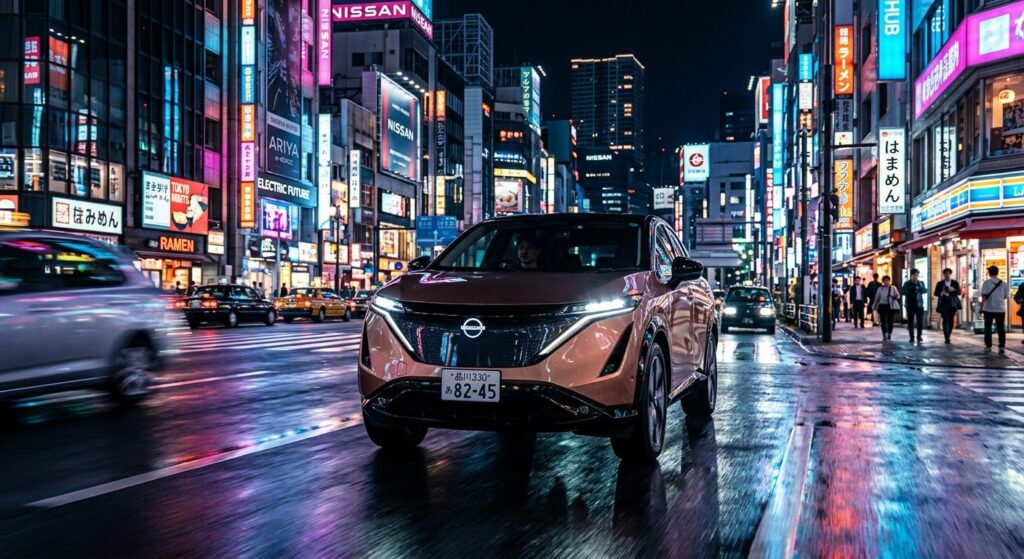
The cabin stands out with its minimalist design and high-quality materials. Real-world usability is strong, especially for long drives due to its quiet ride. Therefore, it is a fantastic option for buyers seeking a more upscale electric vehicle experience without going fully premium.
Pros and Cons of Entry-Level Electric SUVs
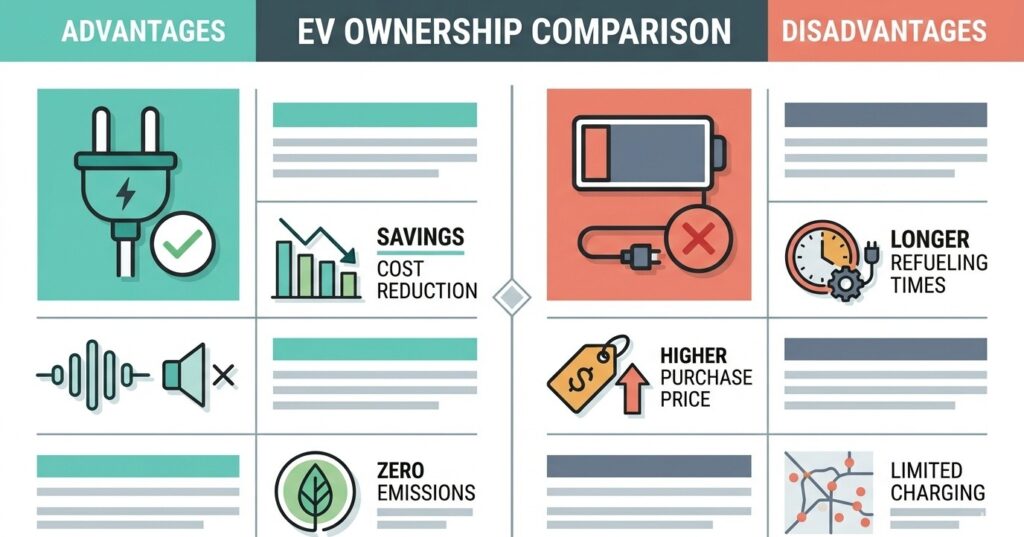
Before considering any electric SUV, you should fetch information regarding the SUV. This information may include some of the SUV’s plus points and some of the drawbacks. These few things help you in making better decisions and buying the best electric SUV according to your needs and budget.
Pros
Below are some advantages of entry-level electric SUVs:
- Lower running costs with fewer moving parts
- Eco-friendly driving with zero emissions
- Quiet performance with smooth handling
- Advanced features like advance driver assistance systems
Cons
Here are some areas for improvement:
- Charging infrastructure varies
- Higher upfront cost
- Range limitations for long trips
Charging Options for Entry-Level Electric SUVs
Charging is one of the most important aspects of EV ownership. For first-time buyers, understanding how and where to charge can significantly impact the overall experience. Some of these options may include explanations.
Modern entry-level electric SUVs support multiple charging options. These include home charging, public AC chargers, and high-speed DC rapid charging. Each option serves a different purpose depending on your driving habits.
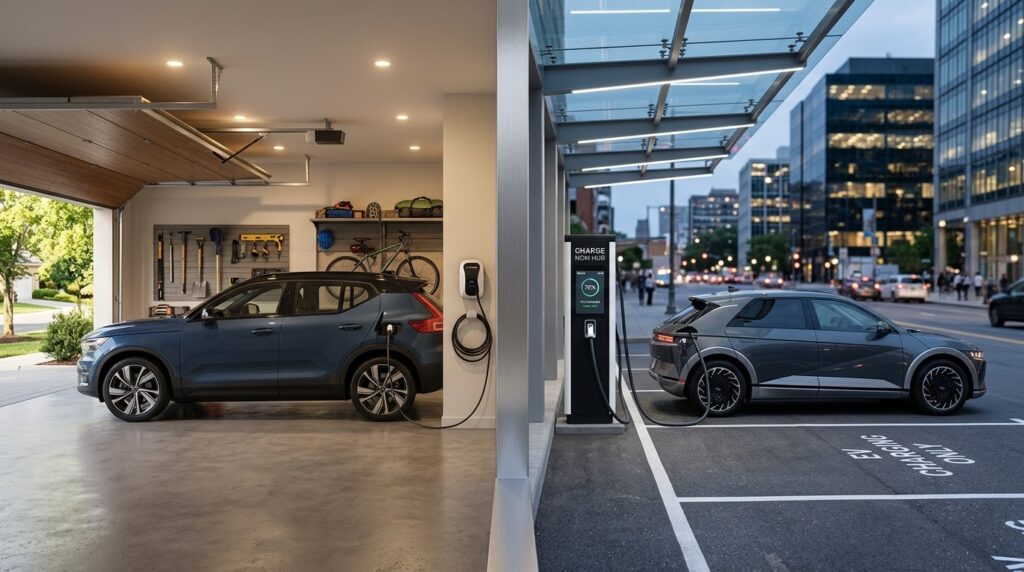
In real-world usage, most EV owners rely heavily on home charging. However, public and fast charging become essential during long-distance travel. Combining all three ensures maximum flexibility.
Home Charging vs Public Charging
Home charging is the most convenient and cost-effective option for electric vehicle owners. By installing a Level 2 charger, you can fully charge your SUV overnight. This is ideal for daily commuters.
In contrast, public charging stations are useful when you’re away from home. These are commonly found in shopping centers, offices, and highways. However, availability and wait times can vary depending on location.
From an ownership perspective, combining both options works best. Use home charging overnight for daily needs and public chargers for flexibility during longer trips with family or friends, ensuring stress-free experiences.
Fast Charging Availability
Fast charging is essential for long-distance travel. Many modern EVs support DC fast charging, allowing you to recharge up to 80% in 30 to 40 minutes. Some brands, like Tesla, offer dedicated charging networks that improve reliability and speed. Meanwhile, other manufacturers rely on expanding public infrastructure.
However, charging speeds vary depending on the vehicle and charger capacity. For example, newer platforms support higher kW speeds, reducing wait times. Therefore, checking compatibility is crucial before buying.
Estimated Charging Costs
Charging costs depend on electricity rates and charging method. Home charging is usually the cheapest, especially during off-peak hours. Public fast chargers are more expensive but offer convenience. For example, highway charging may cost significantly more per kWh compared to home charging.
Despite this, EVs still cost less to run than petrol vehicles in most cases. Over time, these savings add up. As a result, entry-level electric SUVs remain a cost-effective long-term investment.
What is the best entry-level electric SUV in 2026?
The Hyundai Kona Electric and Chevrolet Bolt EUV are top choices. They offer strong range, affordability, and reliability. However, the best option depends on your budget and driving needs.
How long does it take to charge an EV SUV?
Charging time varies by charger type. Fast chargers can reach 80% in 30–45 minutes. Home charging typically takes 6–10 hours overnight.
Are electric SUVs good for daily use?
Yes, they are ideal for daily commuting. They offer smooth driving, low costs, and convenience. Most entry-level models provide sufficient range for everyday needs.
Conclusion
Choosing the best entry-level electric SUVs in 2026 depends on finding the right balance between budget, range, and everyday usability. Models like the Hyundai Kona Electric and Kia Niro EV offer a strong all-round package, while the Chevrolet Bolt EUV stands out for affordability.
Overall, these vehicles deliver excellent value, combining efficiency, modern technology, and lower running costs. If you’re planning to switch, now is a wonderful time to explore your options and compare models to find the perfect fit for your lifestyle.

Cybertruck Problems and Owner Complaints in 2026

Electric SUV Towing Capacity Guide: Which EVs Can Actually Tow? (2026)

How to Check Used Electric SUV Battery Health Before Buying: Complete Guide

Electric SUVs vs. Hybrid SUVs: Which One Is the Better Choice in 2026?

Honda Prologue vs Rivian R2 (2026): Which EV SUV Wins?

Top10 Electric SUVs with the Fastest Charging in 2026
Electric SUV Towing Capacity Guide: Which EVs Can Actually Tow? (2026)

BMW iX3 vs Tesla Model Y: Which Electric SUV Is Better in 2026?

Tesla Model Y Pros and Cons (2026): Real Owner Review

Rivian R1S vs Tesla Model X (2026): Which Electric SUV Should You Buy?
-
 Electric SUV Buying Guide8 months ago
Top10 Electric SUVs with the Fastest Charging in 2026
-
 Electric SUV Buying Guide5 months ago
Electric SUV Towing Capacity Guide: Which EVs Can Actually Tow? (2026)
-
 Electric SUVs Comparisons7 months ago
BMW iX3 vs Tesla Model Y: Which Electric SUV Is Better in 2026?
-
 Electric SUV Brands7 months ago
Tesla Model Y Pros and Cons (2026): Real Owner Review
-
 Electric SUVs Comparisons7 months ago
Rivian R1S vs Tesla Model X (2026): Which Electric SUV Should You Buy?
-

 Electric SUV Brands9 months ago
BYD Tang Overview: 7-seater Electric SUV’s Specs and Top Features
-

 Electric SUV Buying Guide8 months ago
Best Electric SUVs with Long Range: Top 5 best SUVs for Families
-

 Electric SUV Buying Guide7 months ago
Best Entry-Level Electric SUVs in 2026 for First-Time Buyers